Bharat Bhushan | Clueless in Dhaka: Polite Tweet Hits Major Tripwire
US ambassadors to India normally confine themselves to bilateral matters and do not reach out to Indian envoys in third countries such as Bangladesh -- such correspondence usually goes through the US embassy in Dhaka
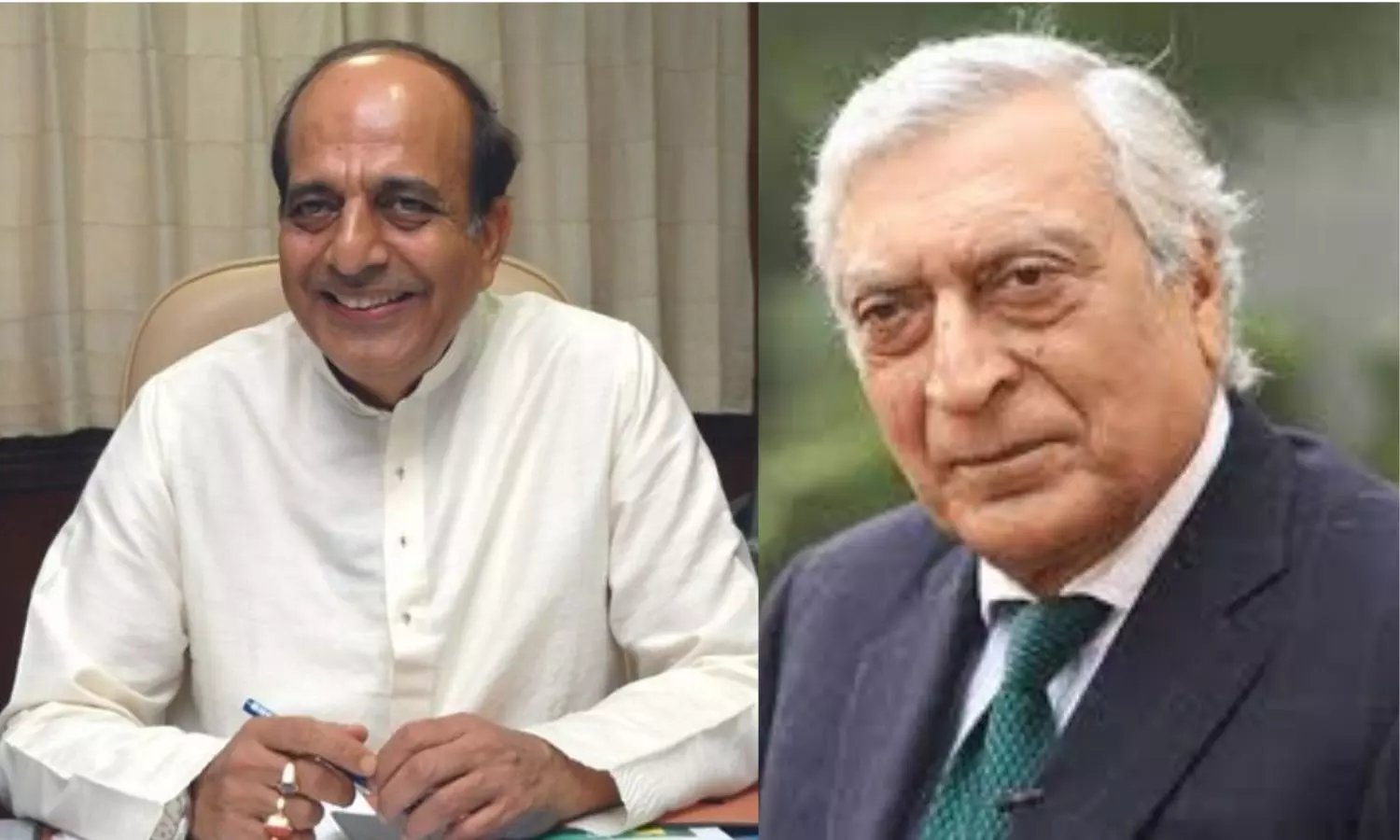
On the day India’s incoming high commissioner to Bangladesh Dinesh Trivedi presented his credentials in Dhaka, he received friendly “warm wishes” from US ambassador to India Sergio Gor. In his X post, Mr Gor said: “As the US special envoy for South and Central Asia, I look forward to working closely with him.” Mr Trivedi reciprocated by saying: “I too look forward to working closely with you.”
This has caused quite a stir.
US ambassadors to India normally confine themselves to bilateral matters and do not reach out to Indian envoys in third countries such as Bangladesh -- such correspondence usually goes through the US embassy in Dhaka. Mr Gor, however, holds two titles -- ambassador to India, which New Delhi acknowledges, and special envoy for South and Central Asia, which it finds problematic.
Former foreign secretary Kanwal Sibal publicly admonished Mr Trivedi on X, saying that he saw no issues on which the US ambassador to India should “work closely” with Indian envoys elsewhere in South Asia, including Bangladesh. Mr Sibal said: “For anything relating to India’s dealings with other South Asian countries, the point of contact is Delhi. By reaching out to you the US ambassador is asserting his wider mandate of coordinating relations within the subcontinent.”
While recognising that Mr Trivedi had replied to Mr Gor as a matter of courtesy, Mr Sibal was making a substantive point: that there was a structural problem when Mr Gor addressed Mr Trivedi as the “US Envoy to South Asia”. It was an assertion that his job description covered India’s relations with its neighbours, including Bangladesh.
Mr Sibal likened this to the 2009 “(Richard) Holbrooke mandate” for Afghanistan and Pakistan, which India had successfully resisted being included in, fearing it would invite outside interference in Kashmir. India had at that point warned that such a mandate covering India would be deeply unpopular. Mr Trivedi, perhaps unaware of this history, had effectively agreed to work with Mr Gor in his disputed capacity.
The government has offered no rebuttal, apparently hoping to let the matter fade -- just as it was former diplomats, not the ministry of external affairs, who objected when Mr Gor was first given his dual title. This leaves the episode framed by the MEA’s own structural ambiguity. Mr Sibal, a known supporter of the Narendra Modi government, was not attacking Mr Trivedi but flagging the nuance, asking pointedly: “On what issues does our new HC in BD intends to work closely with the US ambassador to India?”
Mr Trivedi, reacting with surprise, offered only a courteous non-answer to Mr Sibal -- largely a non-sequitur about global cooperation during Covid and disasters. Mr Trivedi’s reply neither engaged nor rebutted Mr Sibal's actual point about titles and mandates. Mr Trivedi seemed to have misunderstood it as a dig about being too friendly with the US ambassador rather than as a substantive diplomatic point.
Mr Sibal was right about there being little scope for the US ambassador to India and India’s high commissioner to Bangladesh to usefully coordinate. There’s no looming “disaster” in Bangladesh for the two to avert jointly. Some observers note that since the US welcomed Sheikh Hasina's ouster and backed the Muhammad Yunus interim government, the possibility of joint US-India work in Bangladesh is prima facie questionable. India also worked hard ahead of Bangladesh’s February 2026 election to prevent the Jamaat-e-Islami-aligned Islamic forces gaining power. So?
Even with closer coordination, India and the United States could not have prevented Bangladesh from signing 13 agreements with China following Bangladesh PM Tarique Rahman's Beijing visit -- including the Mongla Port modernisation project, the Chattogram economic zone, and the Teesta River management project. India was not a contender for Mongla, and its own Teesta cooperation was undercut by internal political disputes, especially with West Bengal.
Neither the Indian high commissioner nor the US ambassador has any institutional standing to win Bangladesh projects for India. Neither controls financing decisions, the role of Indian states in river-sharing politics, or Bangladesh's sovereign choice of partners. This reinforces Mr Sibal's core point: that India's Bangladesh policy runs through New Delhi, not through Mr Trivedi's personal rapport with a US envoy. No social-media-coordinated push between the two could produce so much as a single project contract.
Mr Trivedi's appointment illustrates the risks of installing retired politicians as envoys to neighbouring countries. They are opportunists riding the gravy train. Mr Trivedi, for example, has the dubious distinction of moving from the Congress to V.P. Singh’s Jan Morcha and the Janata Dal, then to the Trinamul Congress, and finally the BJP, never letting ideology stand in the way of opportunity.
Political appointments to diplomatic posts are not new: Jawaharlal Nehru and later PMs made them too, with mixed results: M.C. Chagla and Nani Palkhivala succeeded, Siddhartha Shankar Ray did not. Heavyweight political appointees, unlike career diplomats bound by bureaucratic protocol, can be more pragmatic, build relationships their own way, secure higher-level access, and offer more candid information.
However, there is a serious downside that makes a strong case for career diplomats in the neighbourhood specifically. Career diplomats carry an institutional memory that political appointees do not. Their relationships carry historical and technical depth -- India-Bangladesh water-sharing, India-Sri Lanka fishermen disputes, India-Nepal and India-Bhutan hydropower treaties -- were built up by diplomats across multiple postings, while political appointees start from a shallow base.
Career diplomats are aware of how to avoid triggering “big brother” anxieties in the neighbourhood, knowing which words and gestures to avoid and how to stay low-key. Politicians instinctively seek visibility, and playing to the gallery can create friction even unintentionally. Diplomats favour slow, process-driven, long-term change; politicians, whose tenure tracks the Prime Minister’s, are impatient for quick results and thus more prone to mistakes.
Diplomats arrive with relationships built over earlier postings; political appointees must build from scratch, often without enough time to capitalise on them. And diplomats offer cross-government continuity with institutional checks, while a politician’s posting is tied to their domestic political fortunes -- undermining the stability state-to-state relationships need.
Mr Trivedi is an early beneficiary of Prime Minister Modi's turn toward appointing retired politicians to diplomatic posts. If the government is dissatisfied with the Indian Foreign Service, the answer is not to replace career diplomats with politicians pulled out of formaldehyde -- the real fix lies in addressing the foreign service leadership and the patronage issues which are increasingly shaping key appointments in the first place.
The writer is a senior journalist based in New Delhi