Anita Anand | India’s Existential Crisis: Why It Is Time For Society To Do A ‘Life Review’

India’s billionaire population in 2025 totalled 284 individuals, making the country third globally after the United States and China. According to Forbes India, the combined net worth of India’s billionaires was approximately $1 trillion. At the same time, the World Bank’s mid-2025 update found that, for the first time, India’s extreme poverty rate had fallen below the global average
Is India, as a nation, and are we, as citizens, facing an existential crisis? The term “existential crisis” has roots in existentialism, a school of philosophy. In existentialism, a crucial stage or turning point occurs when an individual confronts the search for meaning and purpose in life and takes responsibility for their choices. More generally, it is a psychological or moral crisis that prompts an individual to ask fundamental questions about human existence. It focuses on the meaning and purpose of existence at both the collective and the individual levels.
At the collective level, can a nation face an existential crisis? I believe it can. At this point in India’s history, there is such a crisis at both the personal and collective levels, and the two are interlinked.
The recently launched movement by the Cockroach Janta Party (CJP) is demanding accountability and transparency from the government. It urges the government and us, as individual citizens, to reflect on our lives.
A review is about reflecting on what’s working and what’s not. Are we happy, sad, feeling stuck, or just not looking forward to much? What in our lives went well? What didn’t? We should ask the government the same questions. And the government should ask itself the same questions too.
India’s development models have been based on trickle-down theory, which has meant that government economic policies disproportionately favour the upper tier of the economic spectrum (wealthy individuals and large corporations). The assumption has been and remains that this wealth will trickle down to the masses. Let’s look at the Indian reality.
India’s billionaire population in 2025 totalled 284 individuals, making the country third globally after the United States and China. According to Forbes India, the combined net worth of India’s billionaires was approximately $1 trillion.
At the same time, the World Bank’s mid-2025 update found that, for the first time, India’s extreme poverty rate had fallen below the global average. Its latest figures put extreme poverty at about 2.6%. Government spending on welfare schemes has played a major role in this statistic. Programmes covering housing, cooking gas, toilets, piped water, bank accounts and food security have reached tens of crores of households, and the drop in multidimensional poverty is concentrated in exactly those areas. A 2025 study in the Review of Agrarian Studies reported that 26.4% of India’s population remains below the poverty line.
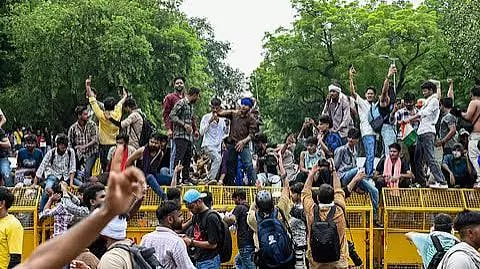
Recent protests in India have focused on government corruption, the leak of a Central exam paper, and the erasure of millions of names from the electoral rolls, fuelling anger and despair.
But corruption in India is nothing new. Its spread and scale are the new norm. This begs the question: Why does it remain such a basic part of our lives? Why can’t we eradicate it? We tell ourselves it is the system. And it is. We console ourselves with the idea that corruption is now a global phenomenon. It is. We accept it.
However, the CJP movement, which now has allies across many sectors of society, is essentially a protest against injustice and callousness not only in the Indian political system but also in social and economic systems.
Increased awareness, largely driven by the Internet and social media, has led people to seek a better life, and the inability to attain it is frustrating. The old norms and traditions, whether it is the joint family system, arranged marriages, or safety nets, are all under threat. No new set of norms has replaced them, other than choices in behaviour, which may or may not work for people. Freedom comes at a high social and financial cost.
How can we deal with existential crises? We could take a leaf from life-review therapy.
Psychiatrist and gerontologist Robert Butler developed life review therapy, drawing on the work of psychoanalyst and developmental psychologist Erik Erikson. The core idea is straightforward: You revisit your life chronologically, not merely to remember events but to actively evaluate them, systematically examining past experiences to find meaning, resolve lingering conflicts, and foster a more cohesive sense of self.
Today, I believe a life review is essential at every stage of our lives. We don’t do this because we haven’t learned how. We reflect little on where we, as individuals and as a society, are headed. And institutions such as families, schools, colleges, workplaces, religious groups and government don’t encourage this reflection. In fact, they see it as a threat to their existence and resist calls for change. But change we must.
The current movements in India are also a fight for democracy, which has been heavily eroded since 2014. While the Prime Minister has taken to calling India the ‘mother of democracy’, his government’s policies and practices do the opposite. The brutal suppression of public protests over the past few months is evidence of this.
Lack of freedom is a common aspect of existential crises. Being an individual means having the freedom to make one’s own choices and being responsible for their outcomes. Yet the current government has chosen to exercise its freedom by curbing the freedom of millions of citizens to lead a decent life. They will have to bear responsibility for their actions.
Until the recent protests, this erosion and suppression of the rights of Indian citizens had created uncertainty about acting, with fear that it may be the wrong choice or lead to undesirable consequences. It had triggered anxiety not only about choice but also about how these choices shape life and existence as a whole. But not anymore.
The Indian government and its citizens are facing an existential crisis. It’s time to take stock. It’s time for a review. It’s a good moment.