Anita Anand | Gen Z questioning elders, and not just tradition… So is it a new era for India?

Young Indians are challenging authority, tradition and social controls with growing confidence
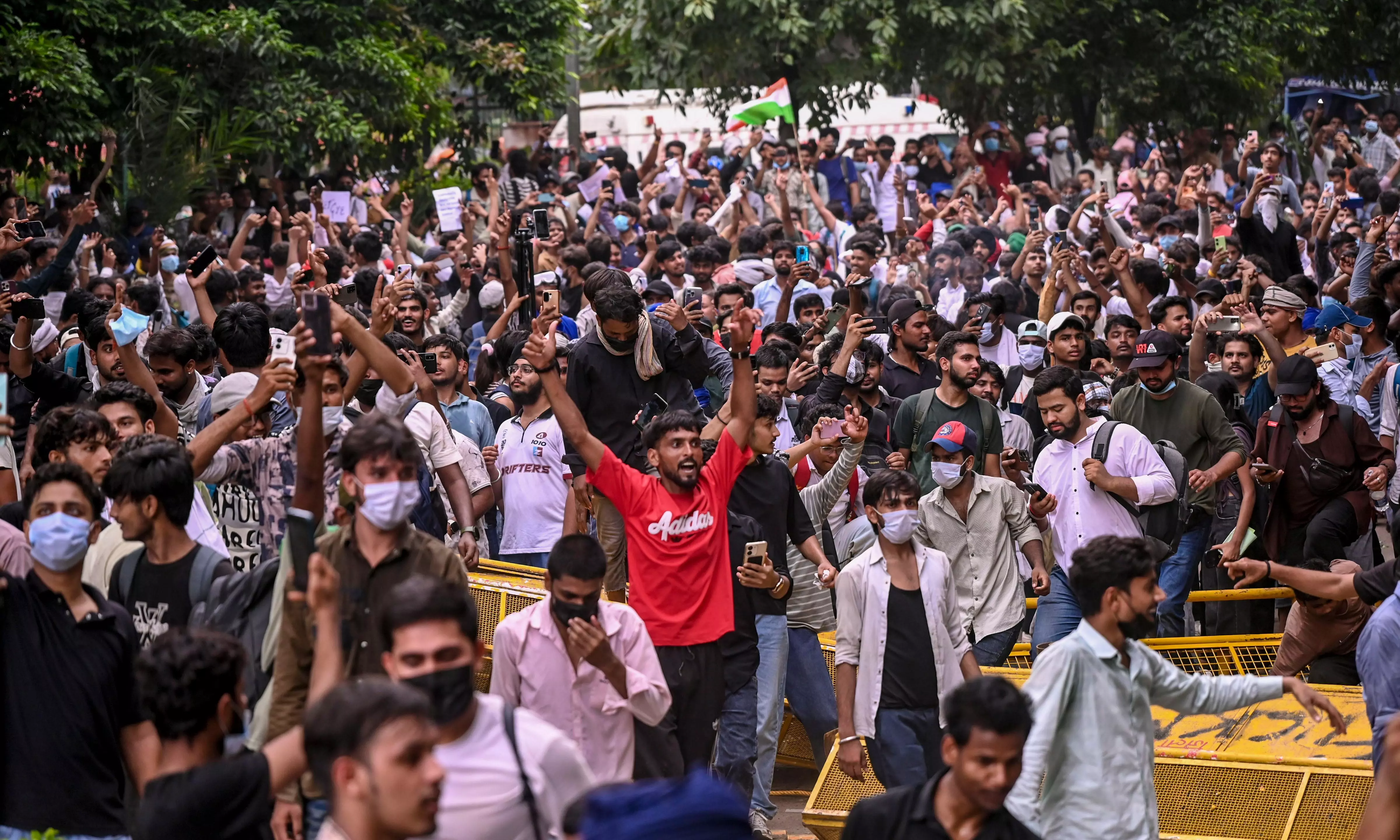
Recently, there has been increased pushback against accepted norms and customs in India.
An example is the birth and growth of the Cockroach Janta Party (CJP). During the June-July protests in New Delhi this year, young people demanded accountability from the Central government for cancelling the medical entrance exams following a leak of the question papers.
One of the fallouts of these protests has been the extensive mainstream and social media coverage focused on women’s behaviour, including bad language, usually the prerogative of men.
In a widely circulated social media video, a 15-year-old girl used expletives that shocked the Prime Minister, prompting harassment and relentless trolling. She was forced to go on social media to apologise for calling the Prime Minister such names. He forgave her, saying she was a child and that it was the elders’ responsibility to guide their children and show them “the right path”.
For weeks, Prime Minister Modi and his ministers remained silent, particularly on the protesters’ demand that the education minister resign over the leaked papers. The government responded with force, beating and water-spraying the protesters, and then followed up by harassing and trolling them.
The youth movement, spearheaded by the CJP, is also a pushback against decades of social norms and traditions in which young people are patronised by older adults across almost every sphere of life, beginning with the family. Age-old sayings such as “elders, such as parents and grandparents, teachers and those in authority, know best” have been questioned by individuals and groups. But at this point in history, it’s a movement.
Young people, minorities, women and those who are disenfranchised are fed up with being told they don’t know better. And it’s not only in urban areas.
Recently, a Haryana khap panchayat decreed that young women’s phones should be smashed (note: not men’s), that live-in and same-sex relationships are not right, and that if people do not abide by these, they will be barred from living in their villages.
Khap panchayats are community councils formed on the basis of shared lineage (gotra) or geographic proximity. They lack legal legitimacy but operate with implicit support from political figures and local law enforcement. They focus on preserving “community honour” by rigidly enforcing social norms, particularly regarding marriage, inter-caste relationships, and women’s roles in society. The khap panchayats have been criticised for their archaic, anti-women, anti-caste and reactionary stands.
But this time, the challenge to their diktats has come from within the villages, from Gen Z on social media, who strongly object, stating that the personal choices of consenting adults trump community custom. The khap panchayat defended its diktat, saying it was a suggestion that parents should control their children and show them the right path. But children, who are technically and otherwise adults, don’t want to be controlled anymore.
Protests and questioning of social conventions and politics are not new in India. However, with the advent of social media and technological advances that enable faster information sharing, protest and critique have taken on a new dimension. They are also more strategic, as the CJP movement has shown, in targeting incompetence in education and government.
Social norms are essential to the functioning of a society, providing individuals with unwritten rules of conduct that guide behaviour across varied institutions, such as the family, workplace, religious and political contexts. But these norms are not static; they evolve over time, shaped by new economic, cultural and technological realities, and the old norms have to be challenged.
Challenging age-old norms is essential to achieving greater inclusivity, equality and acceptance of diverse identities and realities. Pushing boundaries and initiating discussions that lead to positive social change are vital.
The evolution of social norms is evident, particularly in the widening intergenerational gap, which has deepened over the past few decades. India’s development path, marked by colonial legacies, post-Independence nation-building, the 1991 liberalisation reforms, and the digital revolution, has produced stark generational contrasts.
Those born before the 1970s grew up in a society dominated by joint families, caste hierarchies, and patriarchal traditions. Those who came after, especially Millennials and Gen Z, were raised amid transnational media, urban mobility, and neoliberal reforms, making them more receptive to individual choice, gender equality and alternative family structures, and more inclined to question traditional norms. This comes from critical thinking.
Critical thinking, essential in education, is unfortunately not a dominant factor in Indian school and college education because it isn’t emphasised in government-designed curricula. The primary aim has been and remains to obtain a degree, at whatever cost, to ensure job security and its accompanying benefits.
Questioning traditional norms is discouraged and frowned upon, seen as disloyalty to the institution to which the individual belongs. It begins with the family, which withdraws financial and emotional support. Without a sufficient safety net, young people can either break out on their own or return to the family, at the cost of individual growth.
And now, any challenge to authority, particularly the government’s policies and practices, is considered anti-national and unpatriotic.
However, Gen Z is different. They have questioned traditional norms, prompting pushback within and beyond institutions. With the birth of the CJP movement, judges, bureaucrats and heads of institutions who had previously deferred to the current government’s diktats are now speaking out. Minorities have grown more vocal.
In families, young people are challenging their parents to question the activities and beliefs of the BJP, which many of them voted for. Because the idea of education as a major liberator for many Indian families is too important to them, many parents who would have opposed protests and accusations against the government seem to be more open to reason.
Pushback is here to stay.