Abhijit Bhattacharyya | As Ladakh Boils, Statehood For J&K India’s Litmus Test

The predecessors of today’s Ladakh’s population of 300,000 were part of the independent Jammu and Kashmir kingdom from 1839 to October 26, 1947 when its ruler, Hari Singh, acceded to India. Ladakh’s territory was automatically absorbed into Independent India, as part of J&K province
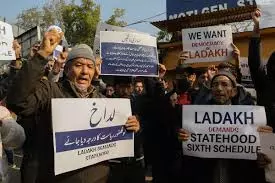
This writer has always maintained that the Constitution of India should not be amended too frequently. A recent report on October 5: “Fact-finding report backs Ladakh statehood and flags resource exploitation by outsiders” reminds us of this. Before going deeper, one must re-examine the geography and other parameters related to Ladakh in a broader context.
The predecessors of today’s Ladakh’s population of 300,000 were part of the independent Jammu and Kashmir kingdom from 1839 to October 26, 1947 when its ruler, Hari Singh, acceded to India. Ladakh’s territory was automatically absorbed into Independent India, as part of J&K province.
The border state of J&K, sharing frontiers with both Pakistan and Tibet, became extremely important due to the congenital hostility of both Islamabad and Beijing, especially after Communist China captured the territory of Tibet. The people of Ladakh have been compelled to live under the shadow of the PLA’s machine-guns lurking around Leh’s plateaus, rivulets and passes. In this scenario, is Ladakh’s demand to be “upgraded” from being a Union territory to a state justified? While it is the duty of political parties to respond to this issue, owing to Ladakh’s location, the unprecedented volatility and violence in a highly sensitive part of India must be kept in mind. The nuances of geography in a vast continent-like country can’t be forgotten. Ignoring this could create more combat-like situations in future.
The eruption of the unrest in Ladakh is a litmus test for the Republic of India due to geography, first and last. With an area of 60,000 sq km, high mountainous terrain, with a population of 300,000 people, Ladakh is precariously sandwiched between Tibet and Pakistan-occupied-Kashmir. Despite their distinct ethnic identity, the people of Ladakh have proved themselves as loyal, valuable citizens of the Republic of India.
Let us remember that the new boundaries of Independent India haven’t brought much happiness to a majority of South Asians from the beginning of 1947. The geography of India was cut into pieces through the middle -- Punjab, Sindh and Bengal by the one-man boundary commission of Sir Cyril Radcliffe. India did not break from the border like the Soviet Union in 1991. India broke from within in 1947.
After 1947, regrettably, Indians themselves broke province after province, many of which shared land borders with two hostile and unfriendly neighbours -- Pakistan and China -- and three politically temperamental, mentally sentimental and mercurial ruling nations of Nepal, Bangladesh and Myanmar.
Will it, therefore, be wrong to suggest that the propensity of independent India’s ruling class to ceaselessly re-create new internal boundaries and re-configure the maps of states sharing frontiers with foreign countries, for domestic political reasons, needs to be eschewed? Let everyone know that not every ethnic or linguistic group, caste, religion or offshoots of any other vintage can have everything in a country of bewildering variety, divergence and differences.
India’s provinces were founded on a linguistic basis under the States Reorganization Act 1956. There are 22 official languages under the Eighth Schedule. But the total number of major languages is 122, along with 1,599 other spoken languages. Can all of these be declared as “official language”? Also, can all claim their own linguistic states?
The irony of the Indian polity is that after 1947, except Madhya Pradesh (2000) and Andhra Pradesh (2014), every other partitioned state shared an international border with hostile, politically unstable or highly volatile neighbours. The Bombay Reorganization Act 1960 split up Bombay state into two states of Maharashtra and Gujarat. Punjab was carved out twice, creating Himachal Pradesh and Haryana (1966). Assam was broken up many times -- Nagaland (1962), Manipur (1971), Tripura (1971), Meghalaya (1971); Mizoram (1986), Arunachal Pradesh (1986). Uttar Pradesh was cut for Uttarakhand (2000) and Bihar was redrawn to carve out Jharkhand (2000). The unprecedented creation, however, came in 2019 when the status of J&K state was demoted, with partition into two UTs of Ladakh and J&K.
Whether all this is good or bad for India is for the country’s rulers to introspect on, and course-correct if necessary. But virtually all of India’s partitioned states with international boundaries face hostile or unstable neighbours, and internally pose increasing challenges. From now on, therefore, let’s not tweak the internal boundary of any border state/UT facing Pakistan, Tibet, Nepal, Bhutan, Bangladesh and Myanmar to avoid an inevitable future disaster.
India’s political class, of whatever ideological persuasion, must not get into the cauldron of conflict and confrontation to divide their own land for short-term gains, rather than addressing key strategic issues.
Let’s again refer to India’s 22 official languages. Do all of them have linguistic states or combat regiments in their names? No. Among the Union territories, Ladakh is the only one to have the Ladakh Scout Regiment. On the other hand, 11 of the 22 official languages do not have any regiment with their names. So what? How does it affect their identity or existence in India? Surely not all linguistic states can demand, as a matter of right, to have a regiment or state. Merit holds away, with or without any regiment or state in the Indian system, minor irritants and aberrations notwithstanding.
There is no Bengal, Goa, Gujarat or Parsi Regiment. Yet, a man from Jamnagar, Gujarat, two Bengalis, one Parsi and an artillery officer from Goa became chiefs of the Indian Army without any embossed regimental identity to their state or language. Hence, no Indian leader should ever claim to have any new regiment for their caste, class, language, religion or state. Administering a land of 1.4 billion demography needs maturity, fair play, objectivity and probity. Rabble-rousing people to spread hatred, revenge or make-belief enmity could pose unforeseen and unexpected challenges to India and its civilizational history.
To protect its geography and polity, India must never do two things. No border province should be cut. And four Union territories -- the Andaman and Nicobar, Lakshadweep and Ladakh in the high hills, as well as the nation’s capital, New Delhi, should never ever be converted into states for reasons that are well understood by the political class of all shades, colour and ideology. Finally, it must be remembered that whereas Ladakh got “promoted” from being part of J&K to a separate UT, Jammu and Kashmir was “demoted” from being a province of India into a UT, which was a first of its kind in the nation’s constitutional history. Therefore, it is the statehood of J&K which deserves to be restored today.
The writer is a Supreme Court and high court advocate. The views expressed here are personal.