Aarnab Mitra | When Generations Clash On How They Speak; And Some Go Into Linguistic Exile

English, as I once understood it, has suffered a military coup. Sometimes my daughter speaks entire sentences that sound like encrypted Nato communications
My parents worried about the generation gap because we listened to loud music, wore faded jeans, and stayed out late at night. Today, the crisis is linguistic. I live in the same house as my Gen-Z daughter, eat at the same table, travel in the same car, but increasingly feel separated not by age, but by vocabulary.
The latest blow to my self-esteem came when my daughter returned from watching The Devil Wears Prada 2 and announced dramatically: “Meryl Streep is such a mother”.
My chest swelled with pride. Tory, my wife, has often been compared to famous women, so I naturally assumed my daughter meant Meryl Streep had reminded her of her mother. By extension, then, I too must possess at least some residual value as a husband. Perhaps I was not the obsolete relic I had feared my daughter thought me to be.
My moment of triumph was short-lived.
At dinner, I cautiously asked what exactly about Meryl Streep’s character had reminded her of Tory.
She looked at me with the kind of pity usually reserved for injured livestock. “Dad”, she sighed, “you’re so old-fashioned… Mother doesn’t mean Mom. It means iconic”.
Phusss!!!
I could almost hear my temporarily inflated self-esteem deflating like a punctured bicycle tyre.
But I should have seen it coming. The warning signs were everywhere.
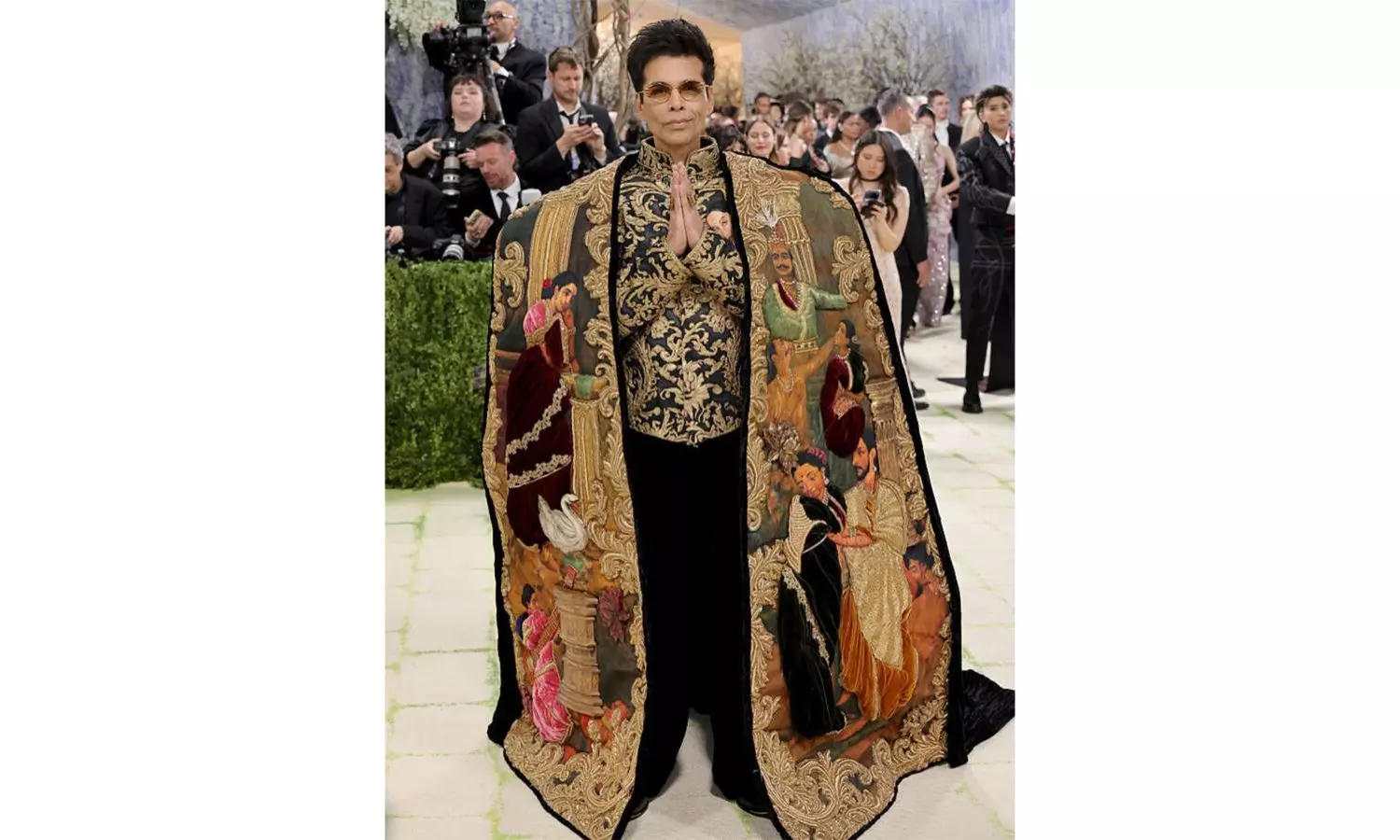
Barely two weeks earlier, my daughter had been positively vibrating with excitement over Karan Johar’s appearance at the Met Gala.
“KJo ate and left no crumbs”, she announced reverentially.
I took that to mean he had committed some horrifying dinner-party faux pas in the full glare of the world media. Perhaps he had gobbled up an entire platter of chicken salad before anyone else got a chance to tuck in. Maybe he had polished off the tiramisu and licked the spoon clean.
Apparently not.
It turned out this bizarre phrase was actually a compliment.
The next day I saw KJo’s outfit in a newspaper. To me, he looked like a Haryanvi villager wrapped in a brightly coloured winter blanket while waiting for a bus to Hisar. If anything, he resembled a painted yurt from Central Asia or one of those giant garden umbrellas before it is unfurled beside a swimming pool.
When I said so, I was informed that I lacked cultural sophistication.
“Ate and left no crumbs”, my daughter explained slowly, as one explains algebra to a Labrador, “means he looked incredible”.
The deterioration of the English language did not stop there.
About a year ago, Shonai returned home in great excitement and announced that she had “tea” on a certain well-known personality.
“You mean you had tea with him.”
She rolled her eyes so violently that I feared permanent optical damage.
“Dad, don’t be facetious. I’m serious.”
This was how I learnt that “tea” is no longer necessarily a beverage. Much as “gay” no longer means cheerful, “tea” apparently means gossip -- preferably scandalous gossip involving betrayal, romance, vanity, or cosmetic surgery.
And that was only the beginning.
I now inhabit a world in which “snack” no longer refers to food but to an attractive person. “Drip” does not mean a leaking tap but an outfit. “Rizz” is charm. “Flex” means showing off. “Baddie” is somehow positive. “Cap” and “capping” have nothing whatsoever to do with headgear. “Slap” is good. “Solulu” means solution.
English, as I once understood it, has suffered a military coup.
Sometimes my daughter speaks entire sentences that sound like encrypted Nato communications.
“That fit is fire. No cap, he’s got rizz. Total snack.”
Go figure!
At such moments I sit silently, nodding faintly like a confused colonial-era civil servant pretending to understand tribal dialects during a census operation.
The transformation extends beyond slang.
Take ketchup.
For almost my entire life, chips and cutlets were eaten with sauce. Tomato sauce. Chilli sauce. Green sauce… Suddenly everybody now speaks only of ketchup. India, it seems, has collectively decided to Americanise its favourite dip.
Our social concerns are also different. We discussed inflation, power cuts, exams, and girlfriends over chai and samosas. My daughter and her friends speak animatedly about “intersectional feminism”, “Brahmanical patriarchy”, “lived experiences”, and “decolonising narratives” over bubble tea, macha and Korean sandwiches.
When I first heard of it, I thought “intersectional” had something to do with traffic crossings at Connaught Place. “Patriarchy”, to me, means being allowed to control the TV remote for seven minutes during a cricket match.
The generation gap has become philosophical. We grew up hearing “Finish your food”. They now say “Check your privilege”.
Frankly, I’m still trying to figure out what “problematic” means.
Pronunciation, meanwhile, has become another battlefield.
I have always pronounced “route” as “roo”.” To me, “rout”, rhyming with “out”, means a crushing military defeat. So, for years I wondered why Internet devices were named after catastrophic battlefield collapses?
I pronounced it “rooter” until my daughter informed me that civilisation had moved on and I was alone in linguistic exile.
The frightening part is that the infection is spreading upward. It is no longer confined to Gen-Zs. I increasingly hear middle-aged corporate executives saying things like “That presentation slapped”, or “The CEO has amazing drip”.
Civilisation, clearly, is in decline.
Still, one must adapt to changing times. Language evolves. Every generation invents its own code words to confuse its parents and irritate its school teachers. Perhaps ours did too, though I cannot remember my father ever having to decode sentences that sounded like malfunctioning artificial intelligence.
So, yes, we live and learn.
I now know that “mother” means iconic, “tea” means gossip, “ate” means succeeded brilliantly, and “snack” is not edible.
But despite being with it, there are still things even my Gen-Z daughter doesn’t know.
She has no idea what “skibidi” means. That’s Gen-Alpha language.
Life has clearly moved on further.
Aarnab Mitra is a senior journalist and an author, most recently of The Wasted Decades 1947-1991