Guha’s own perspective emerges as he closes the section on arguments in support of Gandhi’s ahimsa and presents the voices on the other side, mostly Hindu fanatics and leftists, Indian, Soviet, and Chinese. Guha quotes Gandhi himself on the passive resister: “... should have a generous heart and represent not only his own companions but even his opponents. Whatever rights he secures he will secure for all. He is a friend of all and enemy of none.”
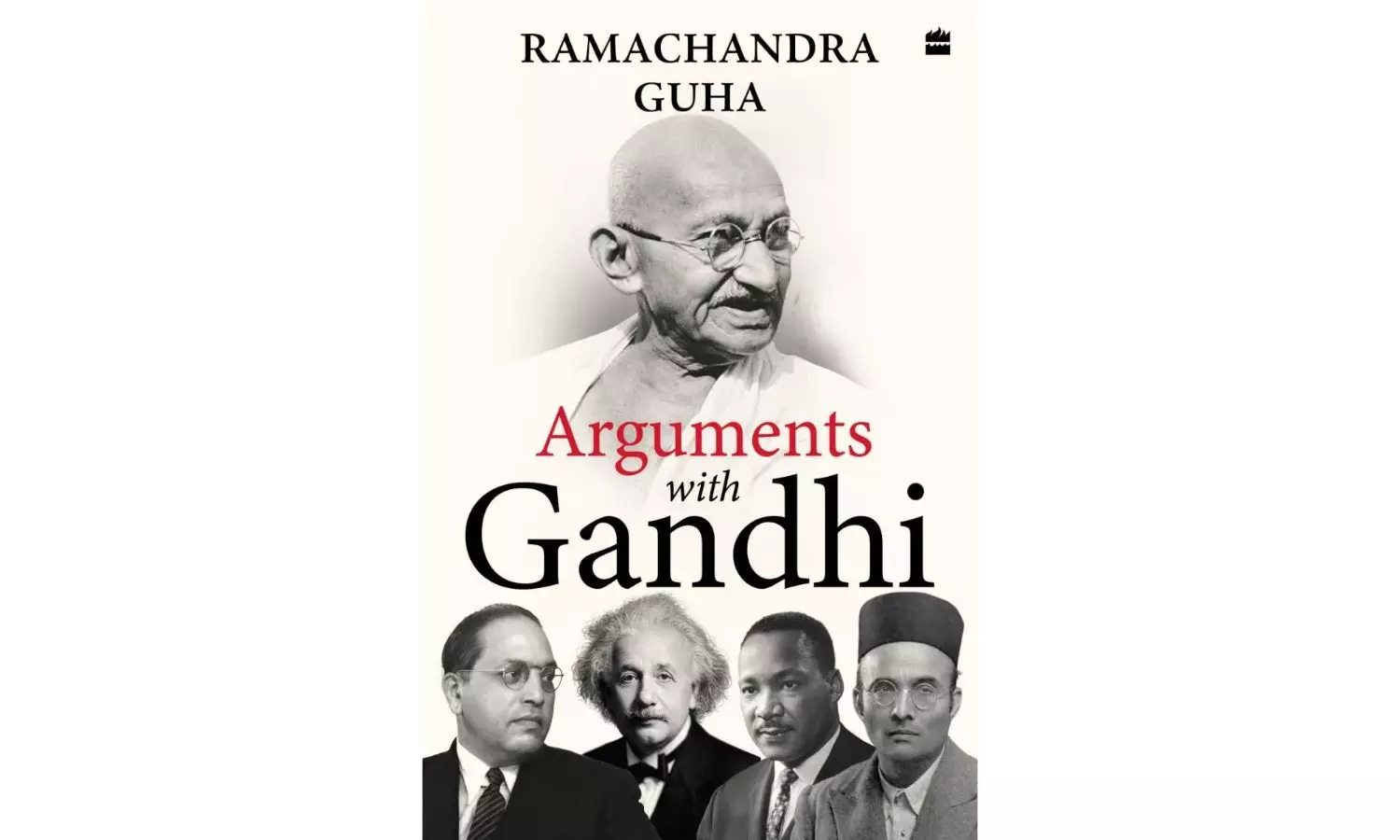
Historian Ramachandra Guha unfolds arguments with Gandhi over four sections, all crucial to Gandhi’s political philosophy. First comes ahimsa, Violence versus Non-violence, the very foundation of Gandhi’s mechanisms of protest. Next, the basis for social action, The Pursuit of Justice. Next up is religion, under the title Debating Faith. Last, and certainly not least, is Gandhi’s view of development, Questioning Progress.
This is no hagiography. It’s a critical examination of the man and his legacy. The title itself can be taken to mean arguments that Gandhi had with contemporaries, or those that Gandhi might have had with succeeding generations. Guha talks not only of what Gandhi said but also of what we can learn from him. And so we have Gandhi in contrast with Savarkar; with many leftists, Indian and foreign, who opposed him; with Ambedkar, who differed strongly with him on caste and other social issues; and with intellectuals, ranging from Einstein to Martin Luther King.
Guha’s own perspective emerges as he closes the section on arguments in support of Gandhi’s ahimsa and presents the voices on the other side, mostly Hindu fanatics and leftists, Indian, Soviet, and Chinese. Guha quotes Gandhi himself on the passive resister: “... should have a generous heart and represent not only his own companions but even his opponents. Whatever rights he secures he will secure for all. He is a friend of all and enemy of none.” Guha comments are revealing: “[Gandhi’s view] had no room for anger or hatred, for demonising or dehumanising the person or institution whom circumstances had rendered into a temporary adversary.”
That view explains the difference between Gandhi and Ambedkar. For Gandhi, the upper-caste oppressor was no enemy, but a neighbour whose well-being mattered. Ambedkar didn’t treat the oppressor as an enemy, but didn’t want to look after his interests as well, which Gandhi did. To that extent, perhaps, Ambedkar was more or a realist than Gandhi. But there’s also the argument that neither Gandhi nor Ambedkar would have succeeded as they did without the other. Ambedkar made Dalits more aware of their rights, and Gandhi made upper castes more aware of what they’d been doing to Dalits.
Bhagat Singh, with his atheism and belief in violence, is Gandhi’s first opponent in the book. Guha first settles the accusation that Gandhi did nothing to prevent Singh’s execution: he presents letters that Gandhi wrote in this regard. He didn’t like Bhagat Singh’s means of fighting for freedom, but was still willing to argue for the stay of his execution.
Gandhi’s last words, by most accounts, were “Hey Ram!” What of the fact that Ram was born to go to war with and to defeat Raavan? Gandhi was unambiguous on violence: offer none, even to a violent or aggressive enemy. And herein lies the rub and the contrast. Even if the WW2 hadn’t taken place making colonies unviable, the ahimsa that Gandhi preached would have quite possibly got India Independence more slowly than other, more vigorous means, such as the pressure exerted by the Royal Indian Navy mutiny which, in turn, was inspired by the INA’s sacrifice. But then, Gandhi’s legacy enabled the country to evolve into a diverse multiparty democracy that has resorted to violence on its own far less often than other recently liberated countries.
And thus to Gandhi and development. Gandhi didn’t look at economic development in isolation. His attitude is clear from “Industrialise — and Perish”, a collection of Gandhi’s writings on progress. At the core of his vision was human development of a kind that didn’t destroy the environment, a vision built around autonomy and education and dignity rather than pure economic indicators. Guha refers to this in the chapter entitled “Gandhi’s Precocious Environmentalism”. Gandhi was no Luddite: he was against the use of machinery for exploitation of all kinds.
Guha makes no pretence of objectivity, but he tries very hard to be neutral, and largely succeeds. And thus, this book gives Gandhi’s thoughts a depth of context that’s unusual today. This book is worth a careful read for anyone interested in Gandhi’s thoughts.
Arguments With Gandhi
By Ramachandra Guha
HarperCollins
pp. 411; Rs 999/-
