The discourse around health has become remarkably reductionist—reduced to prescriptions for sleep, hydration, movement, and nutrition
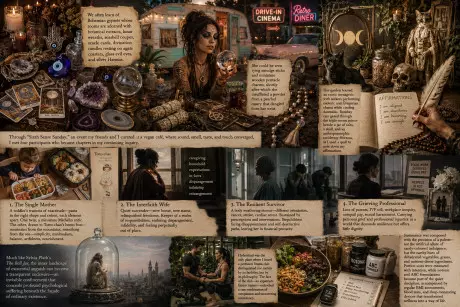
We often learn of Bohemian gypsets whose rooms are adorned with botanical extracts, lunar wreaths, seashell coupes, oracle cards, divination candles resting on agate coasters, glass evil eyes, and silver Hamsas.
Among them was a free spirit who adored drive-in cinemas, and retro diners, travelling in her pastel-hued caravan, where she channelled her purported clairvoyant insights through the mystical medium of a crystal orbuculum. She wore a crescent moon necklet and had an Eye of Horus and a geometric yantra inked on her fingers and shoulders. Her eyes were lined with black soot, and she pasted rhinestones onto the centre of her forehead and along her crow’s feet evoking a surreal aesthetic more reminiscent of Burning Man or Coachella than of any traditional occult imagery.
She could be seen tying smudge sticks and miniature wooden pentacle charms, shortly after which she insufflated a powder from a pearled rosary that dangled from her wrist. This surreptitious method of concealing the illicit substance was the reason her mother-in-law repudiated her.
Her garden housed an exotic menagerie, with seekers performing esoteric and Gregorian chants while circling danmalas. Bombay cats gazed through the triple-moon mirror beside a jar of salts, a skull, and an anthropomorphic taxidermy diorama, as I used a quill to note down my affirmations.
No one indulged in such antiquated folklore as the supposed omen of a black cat crossing the road or the whimsical image of a witch stirring a bubbling cauldron of mystical concoctions.
Through “Sixth Sense Sunday,” an event my friends and I curated at a vegan café, where sound, smell, taste, and touch converged, I met four participants who became chapters in my continuing inquiry.
The first participant—a single mother—spoke of her toddler’s insistence that pasta arrive only in a particular shape and colour, maintaining a strict separation from the other elements on the plate—a tiny connoisseur’s trattoria, where childhood appetite assumed the seriousness of a Michelin critic in miniature. The nursery was less playground than runway: couture, coiffure, composure. Meanwhile, the other twin longed for the simplicity and wa of Totto-chan’s bento box—the beloved Japanese idea of a lunch thoughtfully composed with “something from the mountains” (rice and vegetables) and “something from the sea” (seafood), a quiet ode to simplicity, minimalism, balance, artfulness, and nourishment.
The second participant was in an interfaith marriage defined by quiet surrender—leaving behind her home, adopting a new surname, and relinquishing the freedoms of work, friendships, and independence. She became the keeper of an entire realm of responsibilities: caregiving year after year without the time or space to heal, preparing sustenance, maintaining the household, tending to its daily obligations, enduring appearance-based disparagement, managing errands, caring for her in-laws, and carrying the weight of expectation—all while enduring the infidelity of a husband and the profound estrangement of feeling perpetually out of place.
The third participant spoke of a body weathering its own storms—of a different sexual orientation, battling cancer, the aftermath of a stroke, and the fragility of a heart that had endured cardiac arrest. She navigated the relentless terrain of illness, sustained by prescriptions, hospital corridors, intravenous lines, and the countless interventions that became woven into her daily reality, while carrying the quiet courage required to endure and rebuild. Meanwhile, her stepchildren wandered through semesters of academic disappointment, fractured relationships, compulsive acquisition, and self-destructive indulgence, leaving her in financial precarity.
The fourth participant spoke of a life marked by profound loss and systemic inequity—grieving the absence of her parents while navigating a workplace that penalised her for the very realities of being human: time away to attend their funerals and periods of leave necessitated by the physical toll of IVF interventions. Her time away was measured not with compassion, but through unequal pay and diminished recognition, while she endured the indignity of sexual harassment. She carried the dual burden of personal grief and professional injustice, confronting a world that demanded resilience while failing to offer dignity in return.
Much like Sylvia Plath’s The Bell Jar, the inner landscape of existential anguish can become a transparent enclosure—an invisible confinement that conceals profound psychological suffering beneath the façade of ordinary existence.
Hyderabad was the only place where I found a premium fitness club distinguished not merely by its facilities, but by its philosophy. The face of the club—an expatriate fitness trainer—embodied a rare combination of compassion and unwavering consistency.
Sustenance was composed with the precision of a palette—not the artificial allure of candy-coloured indulgence, but the earthy hues of dehydrated vegetables, grains, and nutrient-dense ingredients, where colour revealed composition rather than concealment. Portion sizes were measured with intention, while isotonic and ABC formulations became part of the quiet discipline, accompanied by regular BMI assessments, blood tests, and sleep-monitoring devices that transformed wellness into something observed and understood, rather than a pursuit of accumulation over intention.
To make physical practice more meaningful, my movement specialist introduced me to the connection between art and the human form. Leonardo da Vinci’s Vitruvian Man was born from his profound anatomical studies, including meticulous dissections of human bodies to understand structure, proportion, and movement. Michelangelo’s David, an Italian Renaissance masterpiece, embodies the metamorphosis of stone into form, reflecting the discipline of sculpting the self through patience, perseverance, and dedication.
It’s philosophy of harmony, between geometry and the body, later manifested in design principles of the Kinesis machine, where the human form became the centre of motion—enabling unconstrained multi-planar movement and ergonomic freedom that honoured the anatomical intelligence for expression. Patience, resilience, consistency, discipline—the quiet dignities of transformation—are sacrificed at the altar of immediacy. We desire the sculpture, but not the chiselling; the summit, but not the climb. We want the masterpiece without enduring the labour that creates it.
The discourse around health has become remarkably reductionist—reduced to prescriptions for sleep, hydration, movement, and nutrition. While these practices matter, they barely scratch the surface of what it means to be truly holistic. Health is equally shaped by what we perceive through our senses, the environments we inhabit, the relationships and energies we engage with, and the degree to which our internal and external states are in alignment.
What remains unseen is the emotional gravity carried by so many—the relentless labour of advocating for justice, preserving individuality, and continuing to show up despite the quiet erosion of energy. Beneath the surface, generations are navigating a collective state of burnout, burdened by the invisible demands of resilience.
I decided to pursue a path of petals and palettes, immersing myself in art therapy and flower remedies in Oxfordshire, where Dr. Edward Bach’s cottage revealed his profound exploration of flora, consciousness, and emotional states. He recognised the unique essence of each flower and its resonance with different states of mind and feeling. Through the sun method, he distilled the therapeutic virtues of flora into a mother tincture, thereby extracting the essence designed to alleviate states of emotional distress, restoring equilibrium within the soul by addressing the emotional cause rather than merely the symptom. His vintage escritoire housed dried petals, roots, herbs, and resins; butters softened by the warmth of human hands; oils steeped with leaf, bark, and blossom; tinctures patiently resting in amber glass; and the slow, deliberate alchemy of mortar, pestle, and brass scales.
A quintessential chocolate-box village idyll, lodging with Mrs Potter—Peter Rabbit’s mother in spirit—surrounded by a charming kitchen garden brimming with organic vegetables. With wholesome English breakfasts prepared on wood-burning stoves, clotted cream shortbread, and tea from the Buckingham Palace, I studied at Edward Bach’s former home while a nearby filming of Midsomer Murders was taking place, in which she had a role.
This marked the commencement of my lifelong inquiry into healing through flora — for fauna and individuals alike. I welcomed individuals beyond the confines of conventional clinics, scheduled appointments, and formal histories, believing instead in an individualised philosophy of care: listening, understanding, and offering customised remedies to support emotional wellbeing.
These remedies were intended to complement existing medical care, aiding individuals in cultivating emotional stability over the manifestation of physical ailments while preserving their autonomy and valuing their inner discernment rather than externally imposed narratives. It was a state of existence shaped by fluctuating intensities of inner unrest: fear, fury, anxiety, bitterness, grief, heightened sensitivity, envy, resentment, and dissimulation.
Pradip Krishen and Peter Wohlleben, through The Hidden Life of Trees, illuminate the forest’s subterranean wisdom — a hidden realm beneath the canopy where roots converse, trees express their arboreal eloquence, and a quiet photosynthesis of ideas unfolds, proving that the oldest conversations are often rooted in silence.
I learned that many seekers sought something organic, minimal, simple, accessible, reassuring, and restorative—an approach that was non-habit-forming and non-invasive. Yet, reaching the core required time, energy, gratitude, consistency, patience, compassion, dignity, and courage. It depended upon each participant’s willpower and positivity to acknowledge, accept, embrace, manage, and ultimately take ownership of their own healing.
Yet healing cannot be confined to the singular pursuit of a pill or a prescription. While every medication holds its place, it also carries inherent limitations; the human experience is too complex to be reduced to a single modality. A more expansive approach invites us to explore diverse pathways by integrating knowledge, practices, and perspectives—to discern what resonates uniquely with the individual. It requires curiosity, discernment, and the willingness to seek the balance that best serves one’s own constitution. Plants are not an alternative medicine; they are the primordial source of humanity’s ancient pharmacopeia.
Beyond the asana is the answer: wellness is not about striking a pose, but sustaining a practice—not a wellness cameo for the well-funded, but an unwavering commitment to the well-founded.
Healing is an art of emotional tending—unfolding like the careful peeling of an onion, layer by layer, revealing the depths beneath. It is a distilled alchemy of ancient rituals and inner transformation. Nothing in nature blooms eternally; evolution requires release, for what is surrendered creates the space for what is yet to emerge. Without the permission to mourn, there can be no true mending. Some delays are divine, and some detours are revelations in disguise. To be intentional with what and whom one permits into one’s sphere, for energy, like emotion, is profoundly transferable.
Across the natural world, the origins of remedies have long existed in the botanical realm, reminding us that healing is not the erasure of pain, but the profound capacity to hold it—to witness it, honour it, integrate it, and transform it. Reminiscing and replenishing require practices that preserve stability while navigating the forces that threaten to undo us; anything that renders us passive in the face of injustice is not healing, but sedation. The universe of restoration is cyclical: like the moon, we move through seasons of fullness and shadow, waxing and waning, yet remaining complete through every metamorphosis.
Like Frances Hodgson Burnett’s The Secret Garden, healing begins with the tending of what has long been neglected. The locked garden becomes an allegory for the inner landscape of the self—an overgrown sanctuary where dormant grief, unspoken longings, and forsaken aspirations lie beneath tangled roots, awaiting the patient cultivation of renewal.
Through nature’s quiet alchemy, the garden awakens, revealing that healing is not merely a return to wholeness, but a rebirth—an inner spring unfolding through seasons of transformation. To heal is to become the gardener of one’s own spirit, loosening the soil of the past, nurturing seeds of resilience, and allowing forgotten possibilities to blossom once more. For, like the petals that surrender to the cycle of the seasons, we too must learn the art of letting go.