Holi is a time of joy, abandon and release, manifested physically in interactions with family and friends and the sharing of colours, and it is a time for music and dance.
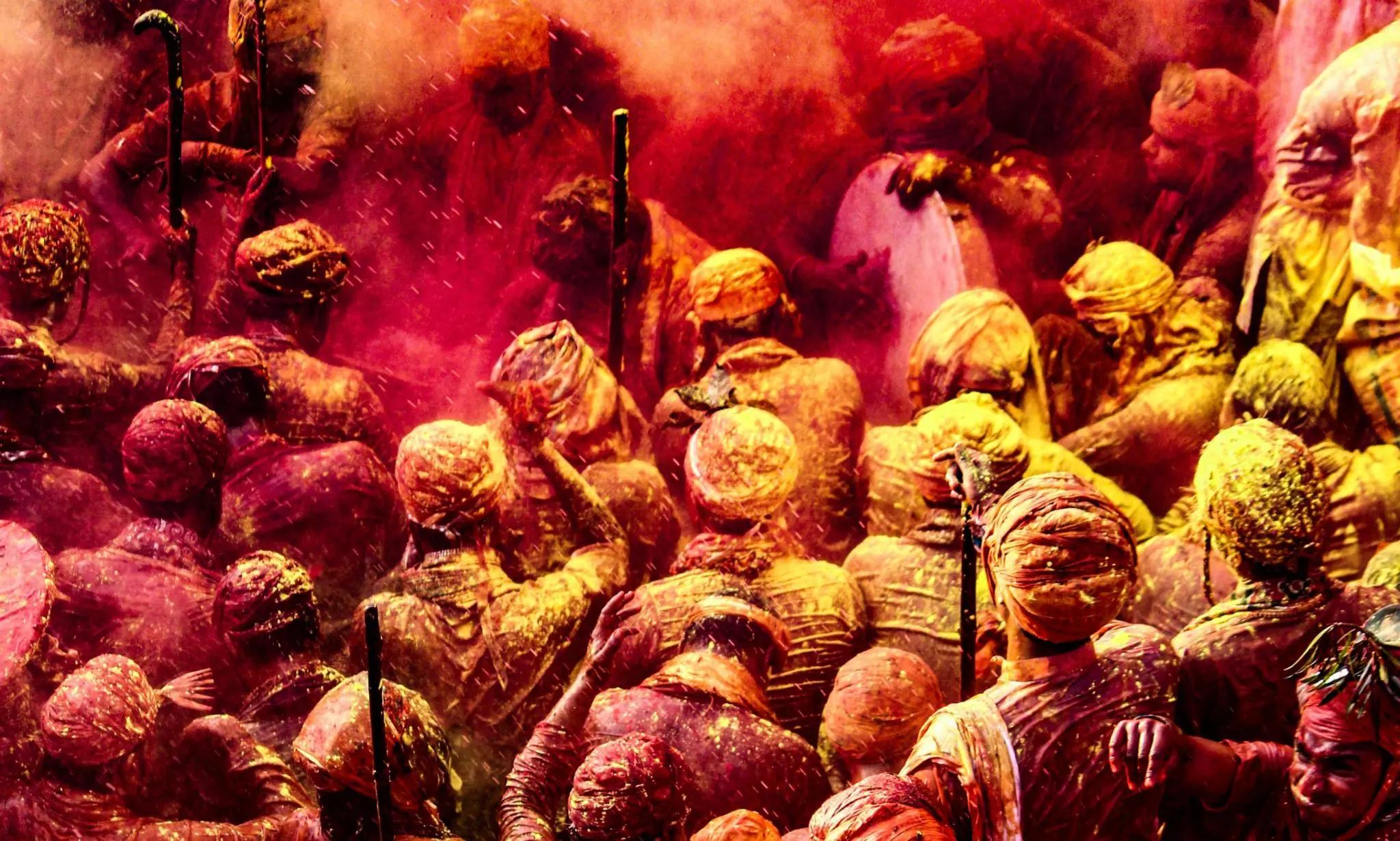
An oft-repeated request on Holi, “Burra na maano, Holi hai”, is generally understood to mean the speaker intends to take a liberty, hence the advance warning to their victim. But as folk and Banaras gharana thumri singer Malini Awasthi explained to a young college-going audience at a concert last week, an older, more traditional context to the words is to let go of grievances and ill feeling, as Holi represents the start of new beginnings in the Spring season. Holi is a festival to bury recriminations, look forward and outward. It’s not only about the colour and consequent allergies; the celebration denotes something much more liberating, she told her audience.
Holi signals the arrival of Spring, but it is also the harbinger of the New Year based on the lunar calendars of India. It is a time of joy, abandon and release, manifested physically in interactions with family and friends and the sharing of colours, and it is a time for music and dance. A time also to feast on special Holi sweetmeats and bhang-laced thandai. As with all Indian festivals, there is the religious story joined to Holi, of the burning of the demoness Holika even while she tried to burn her nephew Prahlad to death. In the southern parts of India, Holi is also associated with the burning of Kamadeva by Lord Shiva.
From the musical perspective, all over north India, and east and west, there is an abundance of Holi songs. There are even Bengali Rabindrasangeets (viz. “rangiyo diye jao”). Of course, Hindi songs are sung most widely as Holi is predominantly a festival focused on Shri Krishna’s Holi with the sakhis of Vrindavan. In Punjab, Holi songs tend to be limited to the folk tradition, though lyrics of love are less-dominant themes, according to Banaras gharana thumri singer Sunanda Sharma. Her birth in Himachal and subsequent marriage to a Punjabi exposed her to many now-lost songs in Punjabi. Jawad Ali Khan, grandson of the immortal Bade Ghulam Ali Khan, says ruefully: “I wish there was an audience for the Punjab ang thumris on Holi, in Punjabi.”
Popular vocalist of the Jaipur-Atrauli gharana, Ashwini Bhide Deshpande, says that in Maharashtra, where Holi is called Shimga, the main celebration involves the ritual burning of Holika rather than the throwing of colours. “Often, I will sing a Hori to end a concert in the season,” she said.
Holi songs encompass several musical genres — from dhrupad to khayal, to bandish thumris, to film songs, and of course, folk songs. The distinction between a Holi thumri and a hori is primarily linked to rhythm — when the song is dominated by the words, not the rhythm, it’s a thumri.
The themes usually focus on exchanging colour with the Lord, a popular example being “rang daaro na daaro mope rang” in raga Bhairavi. Another very popular, somewhat lighter Hori has been immortalised by Vidushi Shobha Gurtu, “rangi sari chunariya” based on raga Pahari. This in recent times has been adapted as a film song with the same name in Jugjugg Jeeyo. One can clearly trace the origins of this composition to a folk tradition, which is also the case in “aaj biraj mein Hori re rasiya”.
Sometimes the songs voice a grievance: “Holi mein khelungi unn sang” in raga Sohni is the distressed lament of a sakhi separated from Shri Krishna, singing, “I will play Holi only with my lord.” A more unusual Holi is in raga Des, “rasiya, tore kaaran, braj mein bhayee badnaam”, and the lament eloquently echoes societal censure even on Holi. Clearly, the licence the festival gives to cast aside one’s reserve is not universal. A recent version of this song by Kasturi Bandhopadhyay is available on YouTube.
Begum Akhtar, today recognised by a younger generation for her ghazals, was a great thumri singer; her Holi-themed thumri “kaun tarah se tum khelat hori” remains an iconic rendition. Here, too, the lyrics gently reprimand. This theme has inspired traditional khayal compositions, most memorably “rang na daro Shamji”, an unusual Holi-themed bandish in raga Sohni composed and immortalised by Kumar Gandharva.
When dhrupads were more popular than khayals 200–300 years ago, Horis were sung in dhammar, a 14-beat taal. Today, Hori dhammars are more closely linked with the haveli sangeet tradition of the Vallabacharya Sampradaya temples, like Dwarkadhish Temple, Shrinathji Temple, and Ranchhodraiji Temple. Jasraj popularised some of these compositions, most notably “Laal Gopal, gulal hamari aankhen mein na daaro ju”.
Sometimes the raga in which the Hori was composed is also one linked to Spring; Wasifuddin Dagar has sung a beautiful Hori in raga Hindol, “Braj mein dekho dhoom machai”. Though the Spring raga Kafi is used extensively for such compositions, Basant and Bahar, too, make their respective appearances.
Interestingly, Channulal Mishra used to sing a rare Hori dedicated to Lord Shiva. “Khelen massane mein holi, Digambar khelen massane mein Holi” shows the festival is not exclusively devoted to Lord Krishna.
Nor are Horis bound by borders, faith or nationality. A most poignant Holi song that showcases the proud owning of disrepute and the linking of spiritual love with colour is sung by the Pakistani Sufi musician Abida Parveen. The lyrics go: “Sab sakhiyan mein chunar mori maili, dekh hasen nar-naari; ab ke bahar mohe rang de” (Of all my companions, it is my scarf that’s tainted; look how the citizens mock me. Colour it, O my lord, in springtime this year).