Floral-Decorated Slab Taken By East India Company Officer In 1816
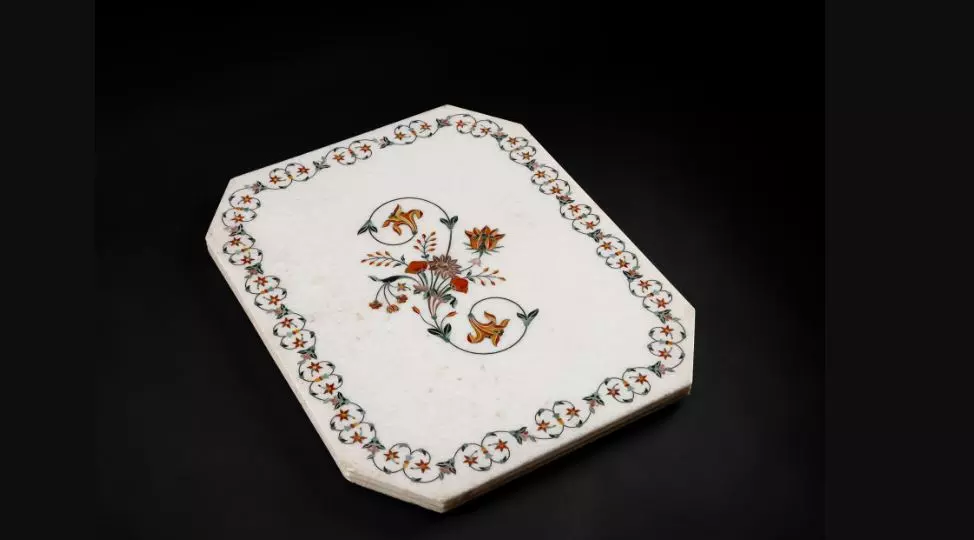
An intricate floral-bordered marble slab taken from the Taj Mahal in Agra by an officer of the East India Company is set to be auctioned in the UK next month.The rectangular slab, one of two that Colonel Pownoll Phipps collected in 1816 at the end of his tenure as superintendent of the repairs of the buildings in and around Agra, is estimated to fetch between 20,000 and 30,000 pounds (INR 24-36 lakh approximately).
It is being offered as part of the Islamic and Indian Art sale by Lyon and Turnbull auctioneers on December 9. "The marble slab is accompanied by a vintage black and white photograph of the Taj Mahal and two letters - one printed by the grandson of Colonel Pownoll and one handwritten by the Marquess of Bath," the auction notes state.
The colonel's son's memoirs quote that his father found them in a 'souterrain', or underground area, at the Taj Mahal and that he thought they were intended for the repairs to the iconic Mughal-era monument. Colonel Pownoll Phipps was born in Devon, England, in 1780. Hailing from a line of soldiers since the early 17th century, he joined the East India Company as a cadet in the Bengal Army in 1799.
After battling troops in Egypt, Phipps returned to India, where he quickly rose through the ranks, becoming Fort-Adjutant and Barrack-Master at Agra in 1809, where he remained for the next seven years. During the colonial era, he was responsible among other things for the care of the Taj Mahal and other historic buildings.
"He took this job most seriously and was at times called upon to prevent damage by Europeans looking for keepsakes. As his son wrote, 'he was once sent for to the Taj, where, in spite of the remonstrances of the sentry, an English lady was insisting on picking agates out of the marble with a steel fork'," the auctioneers note.
In 1816, the colonel was chosen by the Governor General of India to become Superintendent of Building in the Lower Provinces, which meant leaving Agra for Kolkata. His interest in the art and architecture of India remained, however, and he maintained "a staff of very skilful native draughtsmen" who made detailed images of the buildings under his care.
He and his family returned to Britain in 1823, and he died there in 1858. The slab was in the family's collection for over 200 years. "The decoration of the slab is of very fine quality - the design of the floral border is taken from the border around the edge of the upper flat surface of the cenotaph of Shah Jahan in the Taj Mahal, carved and worked after Shah Jahan's death in 1666.
"The central scroll on this panel is very similar to the left hand scroll on top of the same cenotaph, with some elaboration and the addition of an extra floret," read the footnotes to the auction lot for December 9.