Officials said the army's Ibex brigade which had helped in rescue operations in the Mana avalanche of February is preparing to take the help of ground penetrating radars and sniffer dogs to search the missing.
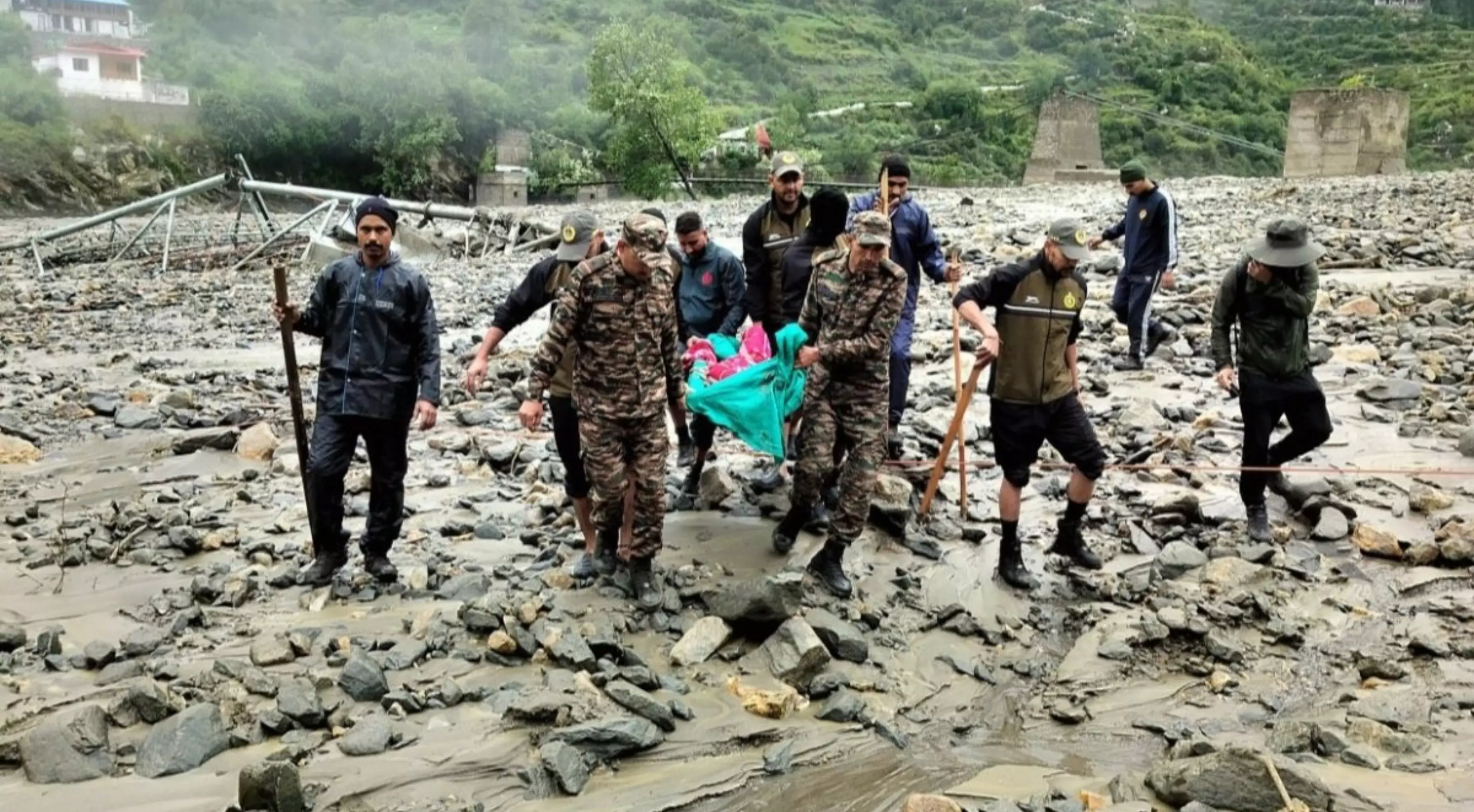
Dehradun: Teams from the Indian Army, ITBP, SDRF, and the State Disaster Management Department launched search and rescue operations on Wednesday in Dharali’s suburban market in Uttarkashi, where major rivers were flowing above danger levels. Nearly all principal rivers in the Ganga Basin are at risk of severe flooding.
As the sun set over the flood-ravaged Himalayan village of Dharali with 190 people rescued and two bodies recovered on Wednesday, fears mounted for those still trapped under the massive river of sludge that buried scores of houses, trees and cars.
Officials said the army's Ibex brigade which had helped in rescue operations in the Mana avalanche of February is preparing to take the help of ground penetrating radars and sniffer dogs to search the missing.
A 28-member group of tourists, who are natives of Kerala, is also among the missing.
“They said they were leaving from Uttarkashi to Gangotri around 8.30 am that day. The landslides occurred along that route. We have been unable to contact them since they left,” a relative of one of the missing said.
Dharali is the main stopover on the way to Gangotri, from where the Ganga originates, and is home to several hotels and home stays.
A Central Water Commission bulletin issued Wednesday morning reported that heavy rains in Uttarakhand’s higher hills have pushed water levels in the Ganga and its tributaries in the Garhwal region above their danger marks. In Haridwar, all major Ganga-basin rivers showed rising or steady trends. The Banganga, a tributary of the Ganga, remained in a “severe situation,” with its level at 231.69 m (0.69 m above the danger mark) and rising at 40.01 mm per hour. At the same time, the Ganga itself stood at 294.20 m, just 0.20 m above its danger mark of 294.00 m.
Upstream at Devprayag, where the river is known as the Bhagirathi, levels were recorded at 464.30 m, 1.30 m above the danger mark of 463.00 m, with a steady flow. Other rivers exceeding their danger levels included the Alaknanda and Mandakini in Rudraprayag district. The Alaknanda was at 627.60 m, 0.06 m above its danger level, though its flow was falling at 400.02 mm per hour. The Mandakini, infamous for the 2013 deluge, was at its danger level of 1,976.80 m with a steady flow near Gaurikund, and at 626.30 m in Rudraprayag town, 0.30 m above its danger mark.
Despite surpassing danger thresholds, current levels remain below the 2013 highest flood levels (HFL). Compared with that year, Banganga is 1.71 m below its 2013 HFL of 233.40 m, Bhagirathi at Devprayag is 10.20 m below its HFL of 474.50 m, Alaknanda is 7.25 m below its HFL of 634.85 m, and Mandakini is 0.55 m below its HFL of 1,977.35 m at Gaurikund (7.70 m below its town HFL of 634.00 m).
An extensive rescue operation only commenced Wednesday afternoon after additional NDRF, SDRF, and Army teams and their equipment were airlifted from Delhi and Dehradun to Harsil. Rescue efforts had been delayed by landslide debris blocking the Gangotri Highway near Netala Gameshpur, Sukhi Tal area. According to the State Emergency Operation Centre in Dehradun, 130 disaster victims were safely rescued under adverse weather conditions.
Earlier, in response to the state’s request, the Centre deployed two Chinook and two Mi-17 helicopters from the Indian Air Force, based in Chandigarh, Sarsawa, and Agra, into Jolly Grant Airport. The Chinooks also airlifted heavy machinery to clear roads into Dharali. Meanwhile, 125 Army personnel, 83 additional ITBP troops, and BRO teams (including six officers and over 100 workers) worked to restore connectivity to the disaster-hit region.