Tiger Reintroduction In MP Reserve Forest Set To Be Pioneering Conservation Measure

India boasts of pioneering the successful reintroduction of tigers in a reserve forest by reviving the population of the big cat in Sariska Tiger Reserve (STR) in Rajasthan in 2008 and then in Panna Tiger Reserve (PTR) in Madhya Pradesh in 2009.
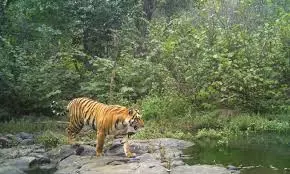
Bhopal: The current move to reintroduce tigers in the Madhav National Park in Madhya Pradesh, the third such initiative in the country, is set to be a pioneering conservation measure, considering the challenges it is facing, a forest officer said.
India boasts of pioneering the successful reintroduction of tigers in a reserve forest by reviving the population of the big cat in Sariska Tiger Reserve (STR) in Rajasthan in 2008 and then in Panna Tiger Reserve (PTR) in Madhya Pradesh in 2009.
“But the current initiative to reintroduce tigers in Madhav National Park stands apart for three key reasons”, Additional Principal Chief Conservator of Forest (APCCF) and field director of Madhav Tiger Reserve (MTR) Uttam Kumar Sharma told this newspaper on Monday.
Madhav National Park was declared a tiger reserve on March seven, 2025.
The tiger reintroduction project in the reserve was launched on March 10, 2023 when two tigers, one male and one female, were translocated to it from Satpura Tiger Reserve (STR) and Bandhavgarh Tiger Reserve (BTR), both in Madhya Pradesh, respectively.
Three days later, another female tiger was relocated to MTR from PTR.
In the second phase of the project, a female tiger was translocated from PTR to MTR on March 10, 2025 and a male tiger was brought to MTR from BTR on April three, 2025
According to him, unlike in Sariska and Panna, which lost their tiger population just a few years before reintroduction, MTR had been deprived of wild tigers for over five decades.
“The ecological and administrative implications of this absence were significant. There was no living memory or field-level experience of managing the wild tigers in the reserve”, Mr. Sharma who is also director of Project Cheetah said.
Another conservation challenge the MTR faces is its urban and infrastructure proximity.
MTR’s boundary directly touches Shivpuri city, and two national highways traverse the reserve.
This is in contrast to Sariska and Panna, whose landscapes are relatively isolated from urban sprawl.
“The proximity of MTR to urban human settlements posed additional challenges in managing human-wildlife interactions”, he said.
Another distinctive feature of the MTR tiger reintroduction is that it was planned, executed, and managed entirely by the Madhya Pradesh forest department, without any external institutional assistance.
In earlier reintroductions at Sariska and Panna, the wildlife institute of India (WII) provided long-term technical and operational support.
The MTR has achieved better reproductive success than Sariska and Panna.
Sariska took more than four years after reintroduction for successful reproduction, while in Panna, first birth took place nearly a year after reintroduction.
In MTR, on September 17, 2024, camera traps captured images of the tigress from BTR with two cubs aged around three months.
The reproductive success within 15 months of reintroduction in MTR is a landmark event indicating successful breeding in the wild in the reserve, Mr. Sharma said.