‘Tiger Abhi Zinda Hain’ Posters Emphasize Nitish’s Hold in Bihar Polls

The Opposition’s high-decibel campaign on issues like “Vote Chori” and “migration” among the state’s electorate found little traction
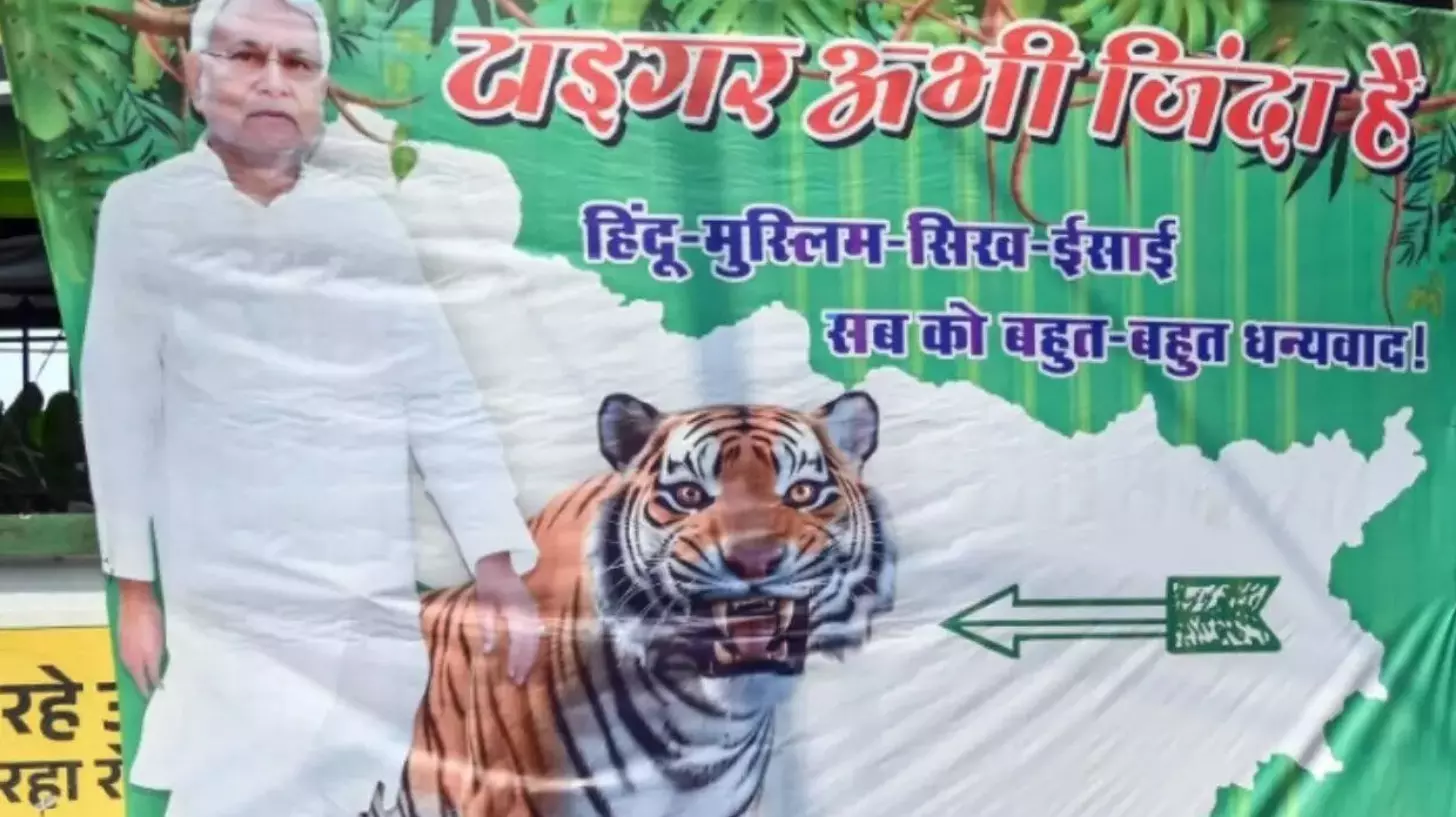
New Delhi: As the Bihar Assembly results rolled in Friday, it was clear the state was hit by a full-blown Nitish storm that tore through every obstacle in its path. JD(U) posters plastered across the state declared “Tiger abhi zinda hain”, sending the message loud and clear: Nitish Kumar was back, stronger than ever.
Brushing aside rumours and a relentless Opposition campaign questioning his “health”, Nitish Kumar’s JD(U), backed by Prime Minister Narendra Modi, virtually led the NDA to a stunning electoral triumph in the fiercely-contested state elections. At this juncture, of the 243 Assembly seats, the NDA seems to be leading by an overwhelming 202 seats to a hard-hit Mahagathbandhan, comprising the RJD, Congress and Left parties, struggling to reach even 40.
The Opposition’s high-decibel campaign on issues like “Vote Chori” and “migration” among the state’s electorate found little traction. The outcome made it clear that the Grand Alliance failed to craft a compelling narrative that resonated beyond its traditional Muslim-Yadav base. Speculation that Prashant Kishor’s Jan Suraj Party (JSP) would damage the NDA proved completely misplaced. The party’s limited but strategically scattered vote share failed to make any impact at the ground level.
As things stand, Nitish Kumar is all set to be the chief minister yet again. Replacing him might not be easy for the BJP as it was in Madhya Pradesh and other states. Posters in Bihar have started appearing: “Bihar ka matlab Nitish Kumar” (Bihar is Nitish Kumar). At the time of filing, while the BJP was leading in 90 seats, the JD(U) was in 84. In the 2020 Bihar Assembly polls, the JD(U) had contested 115 seats and won only 43. This time it had fought in 101 seats, and won 84.
Beyond Nitish Kumar’s generally “positive” image, what firmly placed him at the top of the electoral pyramid were his pro-women initiatives, particularly schemes like “Jivika Didi” which provided Rs 10,000 in the kitty. The Election Commission’s preliminary turnout data indicated that approximately 4,34,000 more women than men turned out to vote in the two phases. In short, women’s turnout was little over 70 per cent as compared to men’s 63 per cent. The overwhelming support from women for the NDA also indicates that it has begun to move beyond traditional caste boundaries.
Another striking feature of the NDA campaign was its single-minded focus on development and the near-total absence of Hindutva and jingoism. The only region where a faint Hindutva undercurrent could be sensed was Seemanchal, which has a sizable Muslim population. Moreover, while the Opposition bickering continued till the last days of ticket distribution, Union home minister and saffron master strategist Amit Shah zipped across the state -- pacifying rebel candidates to oversee booth-level micro management. The BJP’s sustained, on-ground coordination stood in sharp contrast to the relatively limited engagement seen from the top leadership of the RJD and the Congress.
While Nitish Kumar’s dominance remains undeniable, the Bihar polls also marked the rise of “young gun” Chirag Paswan of Lok Janshakti Party. Of the 28 candidates the LJP fielded, it was leading in 19 seats, with a strike rate of 65 per cent. Mr Paswan, who had been waiting in the wings to wrest the top post from Nitish Kumar, could now be angling for the post of deputy chief minister.
The results have put a question mark on Opposition CM face and RJD scion Tejashwi Yadav. Knives in the party and across the Yadav clan could possibly be out for Tejashwi Yadav. That all was not well for him became evident as Tejashwi Yadav somehow managed to crawl to victory from Raghopur Assembly berth with a lead of 15,000 votes after trailing behind the BJP’s Satish Kumar for a significant part of the count.
After catastrophic showings in Haryana, Maharashtra and Delhi, the Congress, under Rahul Gandhi, continued its downward spiral with yet another disastrous performance in Bihar. Out of the 60 seats it contested, the party could manage a lead in a paltry six. In the 2020 Bihar Assembly elections, the Congress had fielded 70 candidates but could only secure 19 seats. The spotlight has yet again turned on Rahul Gandhi for his prolonged absence from the campaign and foreign trips.
The crushing defeat the Congress suffered across the 110 seats Rahul Gandhi had toured on his Royal Enfield for the much-hyped “Vote Adhikar Yatra” sent a clear message: the party and its leadership had been flatly rejected by the people of Bihar. While a deathly silence resonated in the Congress camp, AICC spokesperson Pawan Khera stuck to its “Vote Chori” theme by saying: “The imprint of the CEC is writ large over the results.” The CPI(M-L), which won 12 of the 19 seats it had contested in 2020, was leading in only two seats.
The Bihar story, for now, ended on a bitter note for Prashant Kishor and his newly-formed Jan Suraaj Party (JSP). Launched with great hype nearly three years back, the JSP’s mass contact programme had generated significant buzz, with Mr Kishor’s aggressive campaigning, press conferences and scathing allegations against the NDA and Mahagathbandhan constituents. Yet, despite all the noise and domination in the social media, the JSP failed to even open its account. A political expert was quoted saying: “Despite his reported success as a poll strategist, Prashant Kishor failed to read Bihar.” Ironically, it was Prashant Kishor who had crafted Nitish Kumar’s 2015 poll victory.
At the end of the day, while issues like unemployment and inaccuracies in the electoral rolls remain very real, the NDA succeeded in dominating the narrative. The Opposition, in contrast, struggled to present a coherent or persuasive counter-narrative, allowing the NDA to steer public discourse largely on its own terms.