The Prime Minister hosted the members of the multi-party delegations, comprising parliamentarians and former diplomats, who travelled to 33 world capitals over the past few weeks.
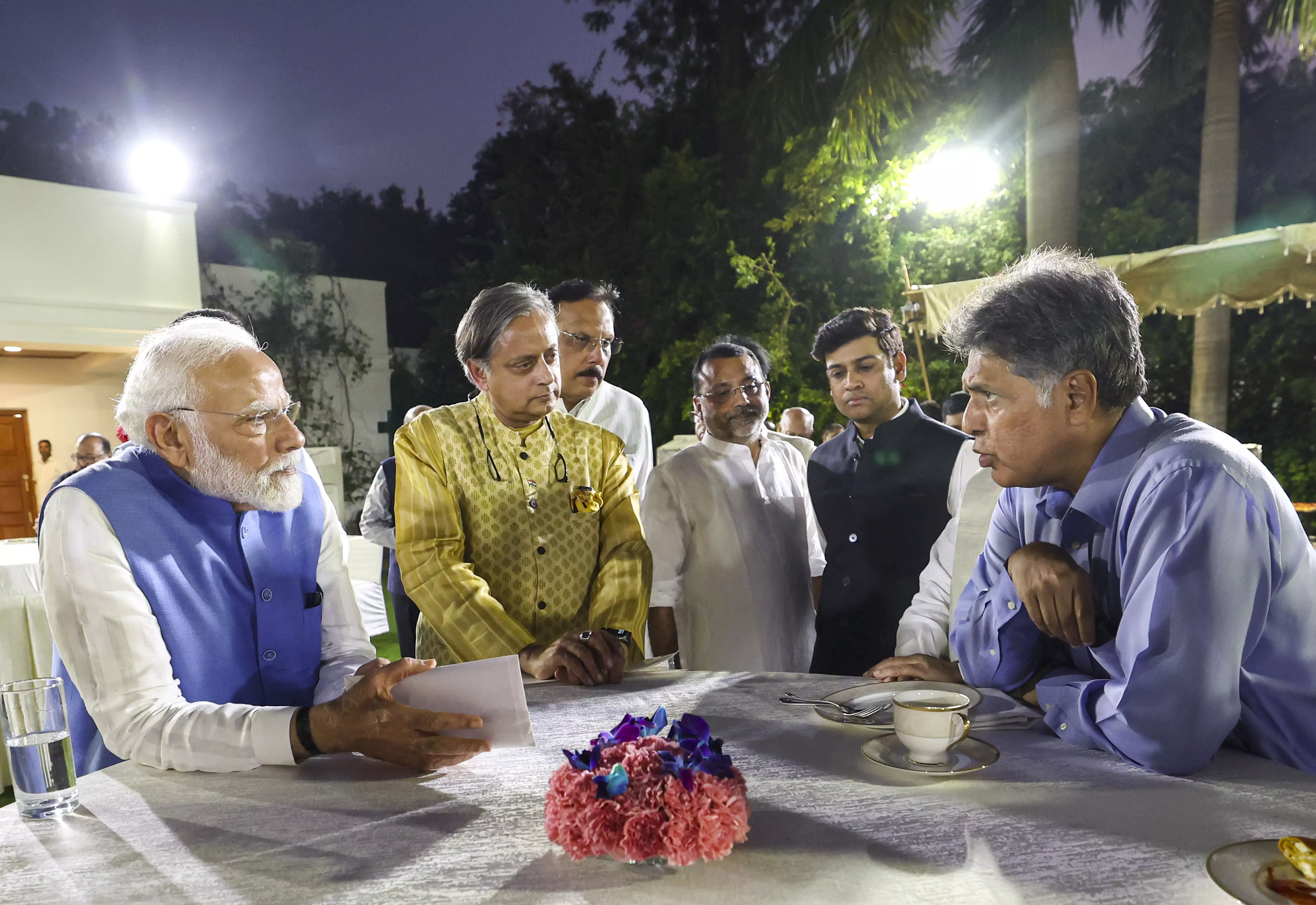
New Delhi:Prime Minister Narendra Modi on Tuesday evening met members of multi-party delegations who had returned after conveying India’s strong "anti-terrorism" stance and the need to eradicate the menace of terrorism post the Pahalgam terror attack and Operation Sindoor in various countries.
The Prime Minister hosted the members of the multi-party delegations, comprising parliamentarians and former diplomats, who travelled to 33 world capitals over the past few weeks. In a post on X, Mr Modi said, "Met members of the various delegations who represented India in different countries and elaborated on India's commitment to peace and the need to eradicate the menace of terrorism. We are all proud of the manner in which they put forward India's voice."
According to an official source, during the meeting with the Prime Minister, the delegation members talked about their meetings in different nations.
"The delegations, consisting of MPs from across party lines, former MPs and distinguished diplomats, had highlighted India's stand against terror and India's commitment to world peace during their visits to various nations," the official said.
Earlier, Congress MP Shashi Tharoor, who led a multi-party delegation to the US and four other countries, said that his delegation had good results everywhere with "very high-quality meetings" and there was a complete understanding for the Indian position.
Mr Tharoor said that from the government's perspective, the purpose of sending MPs both demonstrates the unity of India across political lines and, at the same time, the ability to deliver an effective message to government officials, legislators, think tanks, opinion makers, media and the diaspora abroad. "All of this was very thoroughly fulfilled," he told the media.
"I think it was a very good visit. We were all very pleased with the way all five countries we went to received us. We thought we had good results everywhere. We had very high-quality meetings with Presidents, PMs, vice-presidents, very senior interlocutors," Mr Tharoor said.
The Congress MP from Kerala noted that, at the same time, there was complete understanding and support for the Indian position for why this whole thing had been triggered post-Pahalgam and what our reaction had to be.
"In fact, many of the people we spoke to specifically expressed respect for the restraint we have shown in our reaction. I would say we have come out of this extremely well," Mr Tharoor said, adding that they have done what they were asked to do.
Mr Tharoor noted that what he observed during his visit to the US is that Pakistan has no narrative left to present.
"Not only did everyone understand and accept our point of view, but even the responses from American lawmakers were strongly in our favour... Pakistan's position is extremely weak. They claim they haven't done anything and that India attacked them without provocation, but no one was willing to buy that argument," he said.
BJP MP Ravi Shankar Prasad, who led one of the delegations abroad, said that the delegation which visited six European countries to convey India's position on cross-border terrorism told foreign interlocutors that the military-terror nexus in Pakistan is the main hurdle to peace between New Delhi and Islamabad.
Mr Prasad pointed out that India's stand on the April 22 Pahalgam terror strike and Operation Sindoor was appreciated by the foreign interlocutors, including parliamentarians, ministers and think tanks, during meetings with them.
“We clarified (to them) that we are not against the people of Pakistan. The problem is Pakistan's (Army) generals, with whom Pakistan's people are also fed up,” he said, adding that the Indian delegation conveyed during its meetings with the European leaders that the world has to understand that Pakistan is in the grip of "military generals whose dirty jobs are done by terrorists and their training camps".
“In the new setup in Pakistan, they use terrorism as a proxy. Pakistani generals used these terrorists and their camps as the proxy to make themselves relevant. That's why there could not be any peace,” he added.