Facing electoral decline, both parties reunite to reclaim lost ground and challenge AAP and Congress.
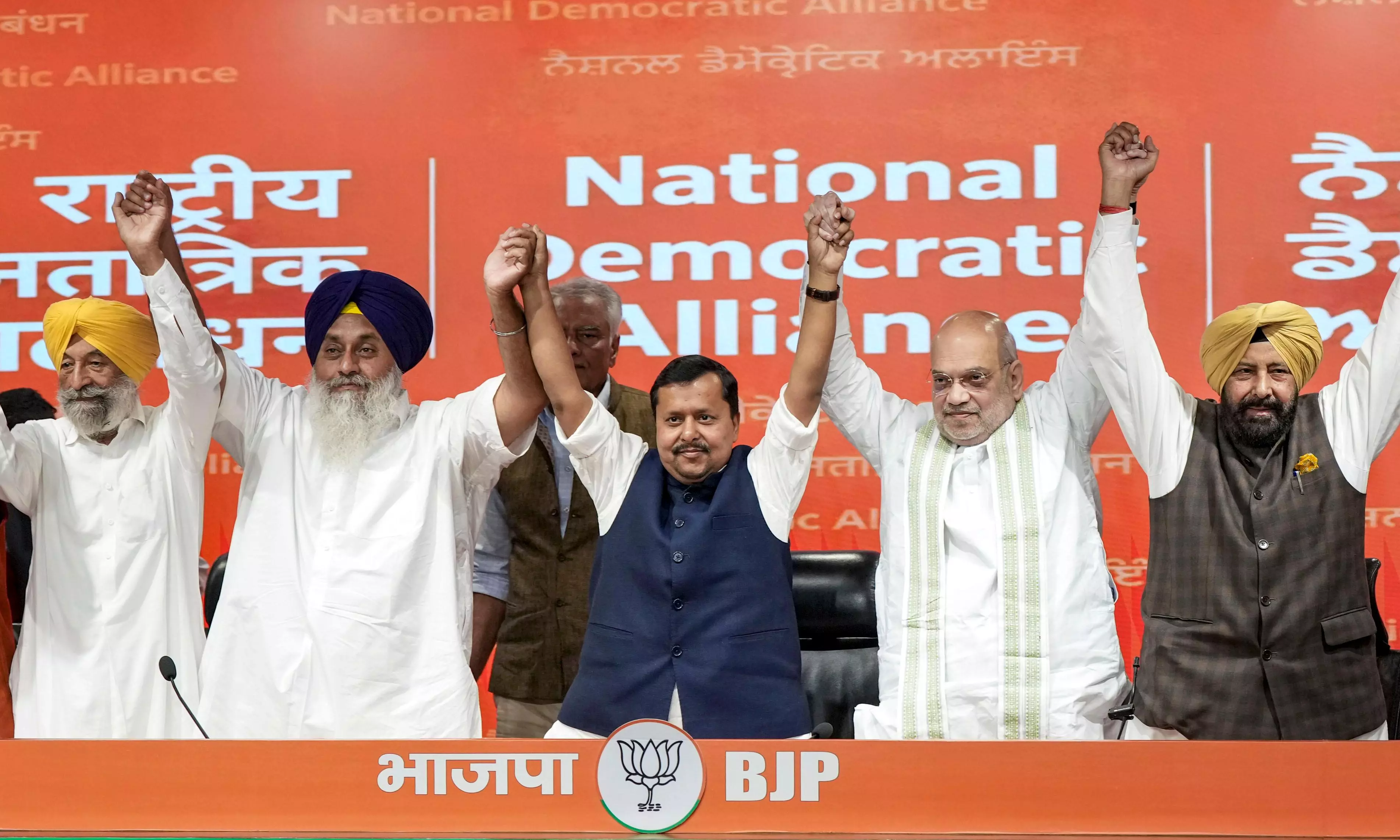
Six years after their bitter divorce, the SAD and BJP are back together, reshaping Punjab's political equations in a reunion driven less by goodwill than by electoral necessity. This is no sentimental homecoming, nor is it about reviving the rhetoric of “bhaichara” (brotherhood). It is a marriage of political convenience, driven by electoral compulsions and a desperate need to survive. Take away the histrionics and drama, and the message is unmistakably clear: Neither party has managed to reclaim lost political ground on its own. Their reunion is, therefore, as much an admission of political weakness and an attempt to regain relevance through an alliance. As Benjamin Franklin had once said, “We must, indeed, all hang together or, most assuredly, we shall all hang separately.” More importantly, the alliance is also aimed at preventing the Congress from consolidating its position in a state where it currently appears to have an edge.
Yet, the alliance, which broke down in September 2020 over the Narendra Modi government’s three controversial farm laws, had been one of the most enduring political partnerships in the country. The Akalis walked out of the NDA, with Harsimrat Kaur Badal resigning from the Union Cabinet as the farmers’ agitation gathered momentum. The laws were eventually repealed, but the political damage to the relationship was difficult to repair. The six-year separation has not been rewarding for either of the outfits. In the 2022 Assembly elections, the SAD was reduced to three seats, and the BJP managed just two in the 117-member House. The Aam Aadmi Party (AAP) swept the polls with 92 seats while the Congress somehow tucked in 18 seats. If Congress suffered a humiliating setback, the electoral collapse of SAD and BJP was even more disastrous. The reunion is, therefore, based mainly on political pragmatism. For the BJP, the Akalis offer something it has struggled to build in Punjab — an established rural network and access to a section of the Sikh electorate. The attempt to milk the 1984 anti-Sikh riots for electoral mileage failed to deliver the expected dividends, and in the 2024 Lok Sabha elections, the BJP failed to win even a single one of Punjab’s 13 seats.
The BJP’s decision to concede the position of “bada bhai” (senior partner) to the SAD and virtually accept Sukhbir Singh Badal as the alliance’s prospective chief ministerial face is a calculated act. Despite its decline, the Akalis still retain a political network, a historical legacy and connection with the Sikh electorate. Aware that its association with the contentious farm laws controversy has further complicated the BJP’s efforts to win back the confidence of Punjab’s farming community, the party has little choice but to use the SAD as its political gateway to Punjab. However, SAD also has vulnerabilities. The 2015 sacrilege incidents and the subsequent police firing at Behbal Kalan and Kotkapura continue to haunt the party. Its association with the drug menace remains a political liability.
As for SAD, the alliance provides a political lifeline. It offers Sukhbir Singh Badal an opportunity to reclaim the lost ground, retain his chief ministerial claim and prevent the party from slipping further into political oblivion. It also gives SAD access to the Hindu support base and, of course, Central resources. Home minister Amit Shah’s assurance on reopening the Kartarpur Sahib Corridor is another significant political concession that Mr Badal can take to the Sikh voters. Mr Shah has allowed Mr Badal to project the BJP alliance as a means of addressing an important panthic concern. But then, the price of this rehabilitation could be steep. To borrow from Shakespeare’s Merchant of Venice, the price of this rehabilitation could well be a pound of flesh. The SAD just might have to accommodate the BJP’s growing appetite for seats and, more importantly, explain to Punjab’s farmers why a party it once abandoned over the farm laws is now an acceptable political partner.
For the AAP, burdened by a heavy dose of anti-incumbency, the reunion presents a challenge on two fronts. While the SAD has drawn support from rural Punjab and sections of the Sikh electorate, the BJP has a stronger presence in urban areas and among sections of Hindu voters. A coordinated campaign could give SAD-BJP a wider reach than either of the outfits managed independently. And then there is the Congress factor. The Congress remains a powerful player and is working to overcome its internal divisions. Its traditional support among sections of dalits, rural voters and other constituencies could complicate electoral arithmetic in this triangular fight.