PM Modi leads high-level security meet as Indian forces launch decisive counteroffensive, targeting terror camps and military bases deep inside Pakistan.
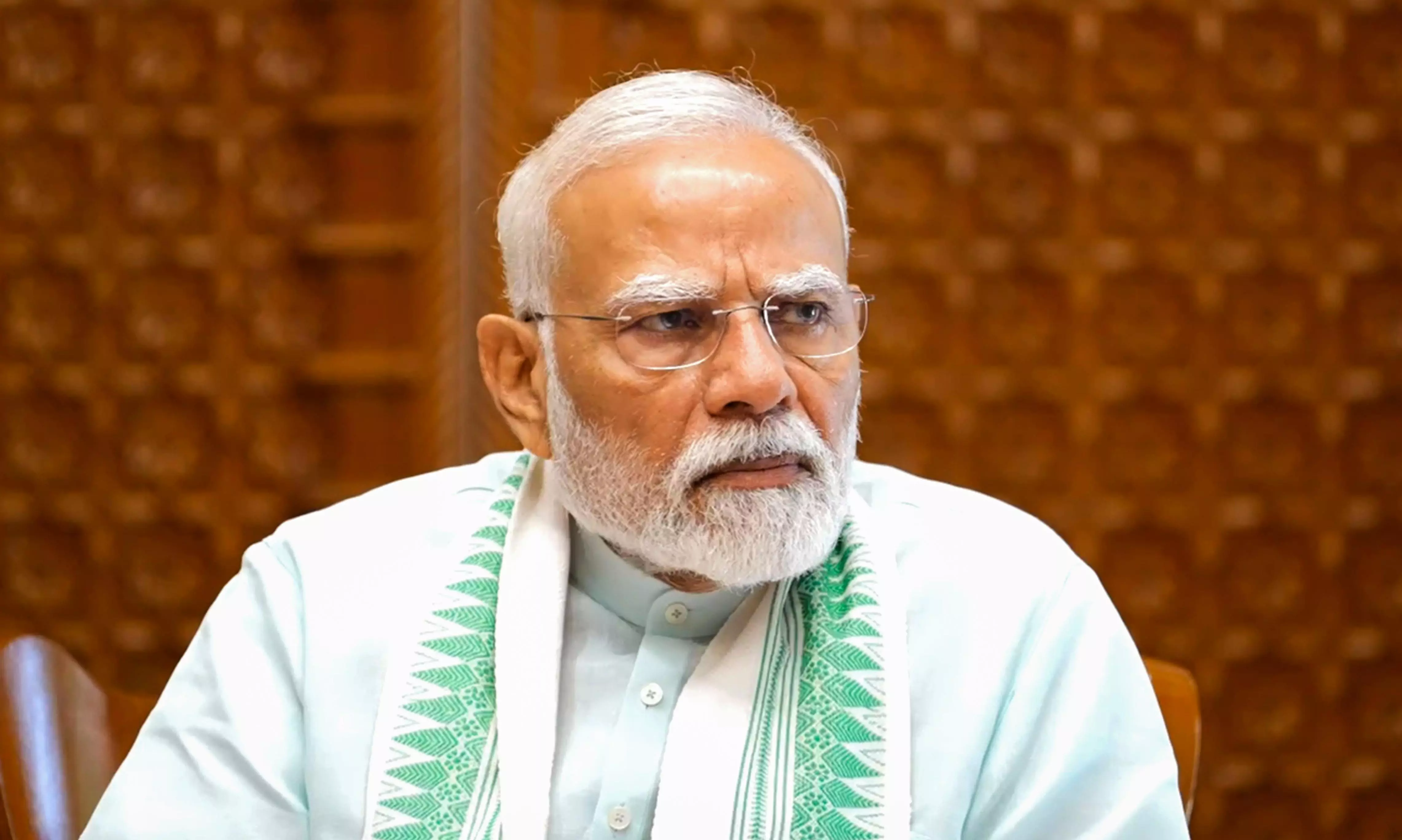
New Delhi: Prime Minister Narendra Modi on Sunday held a key security meeting following Pakistan's breach of the ceasefire agreement, where he unequivocally told the armed forces that, "wahan se goli chalegi, toh yahan se gola chalega" (Respond to bullets with artillery shells).
The Indian Army on Sunday sent a clear message to Pakistan Director-General of Military Operations (DGMO) over the hotline on their violation of the understanding of ceasefire and its intent to respond to these fiercely and punitively if repeated, said Indian Army DGMO Lt Gen. Rajiv Ghai during a joint press conference by the three services.
This even as Barmer district authorities in a tweet on Sunday night asked the public to stay inside their houses as incoming drones activity was spotted.
Army chief Gen. Upendra Dwivedi also reviewed the security situation following ceasefire violations by the Pakistan Army with the Army Commanders of the Western border. He granted full authority to the Army Commanders for counteraction in the kinetic domain to any violation of the understanding reached via the DGMO talks of May 10.
“However, disappointingly and, should I add, expectedly, it took only a couple of hours for the Pakistan Army to violate the (ceasefire) agreement by cross-border and LoC firing followed by drone intrusions across the expanse of the Western fronts, through last night and in the early hours of Sunday morning. These violations were responded to robustly and dealt with as they must be,” said Lt. Gen. Ghai. He is scheduled to speak with the Pakistani DGMO again on Monday afternoon on the ceasefire agreement.
The Indian armed forces attack during Operation Sindoor resulted in the killing of over 100 terrorists, including some of the high-value targets like Yusuf Azhar, Abdul Malik Rauf and Muddasir Ahmed, who were involved in the hijacking of IC814 and Pulwama blasts, said Lt Gen. Ghai.
Indian forces also damaged key military installations close to Pakistan's capital, Islamabad, and brought down a few Pakistan Air Force aircraft, which were trying to intrude into India. Some 35-40 Pakistan Army officials were killed during the ceasefire violation at the LoC.
Indian Air Force Air Marshal A.K. Bharti said Operation Sindoor effectively destroyed terror camps, achieving its objectives with precision. He stressed that the operations' impact is evident to the world. Addressing the press briefing, Air Marshal Bharti said, "Have we achieved our objectives of decimating the terrorist camps? The answer is a thumping yes… The results are for the whole world to see." He also showed pictures and videos of terrorist camps and Pakistan military airbases hit by the IAF.
On any aircraft lost by the IAF during the operation, he said, “We are in a combat scenario… losses are a part of combat… We are still in a combat situation… All our pilots are back home.”
Lt Gen. Ghai also paid tribute to five Indian fallen heroes and civilians who "tragically lost their lives" during Operation Sindoor. "We have thus far exercised immense restraint and our actions have been focused, measured and non-escalatory. However, any threat to the sovereignty, territorial integrity and safety of our citizens will be met with decisive force," he said.
The meeting with the PM was attended by defence minister Rajnath Singh, national security adviser Ajit Doval, the Chief of Defence Staff and three services chiefs. The meeting assessed the current situation and strategised India's response to Pakistan's actions.
The defence minister said that under Operation Sindoor, Indian armed forces not only struck Pakistani military bases near the border, but their might was even felt in Rawalpindi where the headquarters of the Pakistani Army is located.
Singh said the Indian military has punished anti-India forces and terrorists who had wiped off the vermilion of many families through the Pahalgam terror attack. Speaking virtually at an event in Lucknow to inaugurate a BrahMos production unit, he said Operation Sindoor is not just a military action but a symbol of India's political, social and strategic will against terrorism.
"This operation is a demonstration of India's strong will against terrorism and also the capability and determination of the military power," Singh said. "We have shown that whenever India takes any action against terrorism, even the land across the border will not be safe for the terrorists and their masters."
Singh said Indian forces launched Operation Sindoor with the aim of destroying the terrorist infrastructure in Pakistan."We never targeted their civilians. But Pakistan not only targeted civilian areas of India but also tried to attack temples, gurdwaras and churches," he said, adding, "The Indian Army has displayed valour and courage as well as restraint and has given a befitting reply by attacking many of Pakistan's military bases."
The defence minister said the whole world saw the consequences of committing and getting terrorist incidents carried out in India.
“After the Uri incident, our army entered Pakistan and carried out surgical strikes. After the Pulwama attack, we carried out Balakot air strikes and now the world is seeing how India entered Pakistan and carried out multiple strikes following the Pahalgam attack,” Singh said.
"Following the policy of zero tolerance against terrorism, our Prime Minister has made it clear that this is the new India which will take effective action against terrorism on both sides of the border," he said.
