Lal Thanhawla: The Boy from Zarkawt and the Making of Mizoram - This is a book about one of the most able politicians of Mizoram, Lal Thanhawla, who started out as a protégé of Laldenga, the leader of the Mizo National Front (MNF)
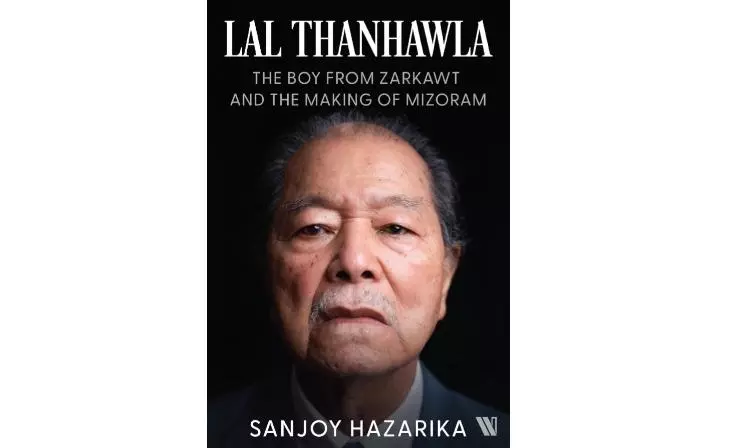
This is a book about one of the most able politicians of Mizoram, Lal Thanhawla, who started out as a protégé of Laldenga, the leader of the Mizo National Front (MNF), the insurgency group which fought a 10-year war with the Indian government, and which entered negotiations that lasted nearly a decade, and ended with the Mizo Accord of 1986 under the then new and young Prime Minister, Rajiv Gandhi. Lal Thanhawla was also encouraged by then chief minister of Assam, Bimal Prasad Chaliha. Lal Thanhawla played his political cards shrewdly, and when peace came, he emerged a statesman-politician, who put the interests of the Mizos and of India at the top of the agenda. But Sanjoy Hazarika’s focus in the book is not just Lal Thanhawla, the patrician politician, because that would not reveal the complex reality that Lal Thanhawla had to tread. Hazarika weaves an absorbing narrative that frames the changes in Indian politics and in the politics of the Mizos.
The author describes the economic and social situation of the Mizos and how the military approach of the army to deal with simmering insurgency had ironically followed the strategy adopted by the British forces in Malaysia to root out communist insurgency in the late 1950s, and the Americans had followed a similar plan in Vietnam. It was that of moving people from the villages they had been living for generations into new sites called protected and progressive village (PPVs) and regrouped villages (RVs) in order to counter and curb the insurgents. In the process, they ended up antagonising and alienating the people. Hazarika shows the wrongheaded approach adopted by the army with regard to the Nagas and the Mizos.
Lal Thanhwla, trusted by Laldenga, soon recognises that violence to wrest the rights of the Mizons would only result in harm and stress to the Mizos. In many ways, Lal Thanhwla, the farsighted politicians, might seem unheroic in comparison to Laldenga. But it is Lal Thanhawla who adopts mainstream politicking, who stands as an anchor in the shifting political grounds. It is often overlooked that the Mizo settlement is in two parts. The first is between the Government of India and Laldenga of MNF, and the second is between the MNF and the Indian National Congress. Lal Thanhawla who is the chief minister of Mizoram at the time steps down and Laldenga becomes the chief minister, and Lal Thanhawla joins the MNF-Congress coalition government as deputy chief minister. While the MNF-Congress accord is signed on June 25, 1986, the one between the Government of India and the MNF is signed on June 30, 1986.
Politics in Mizoram took many turns post-1986, and Lal Thanhawla continued to play a role, not always successful. The most interesting part is that he remained with the Congress through more than half-a-century of his political career. His steadfast politics should serve as a good example not just in Mizoram but the country at large.
Lal Thanhawla: The Boy from Zarkawt and the Making of Mizoram
By Sanjoy Hazarika
Westland Books
pp. 388; Rs 799
