He points out the problem that a Hindu faces. He points out that Hindu parents do not raise their children on the basis of concepts and precepts stated in the Upanishads
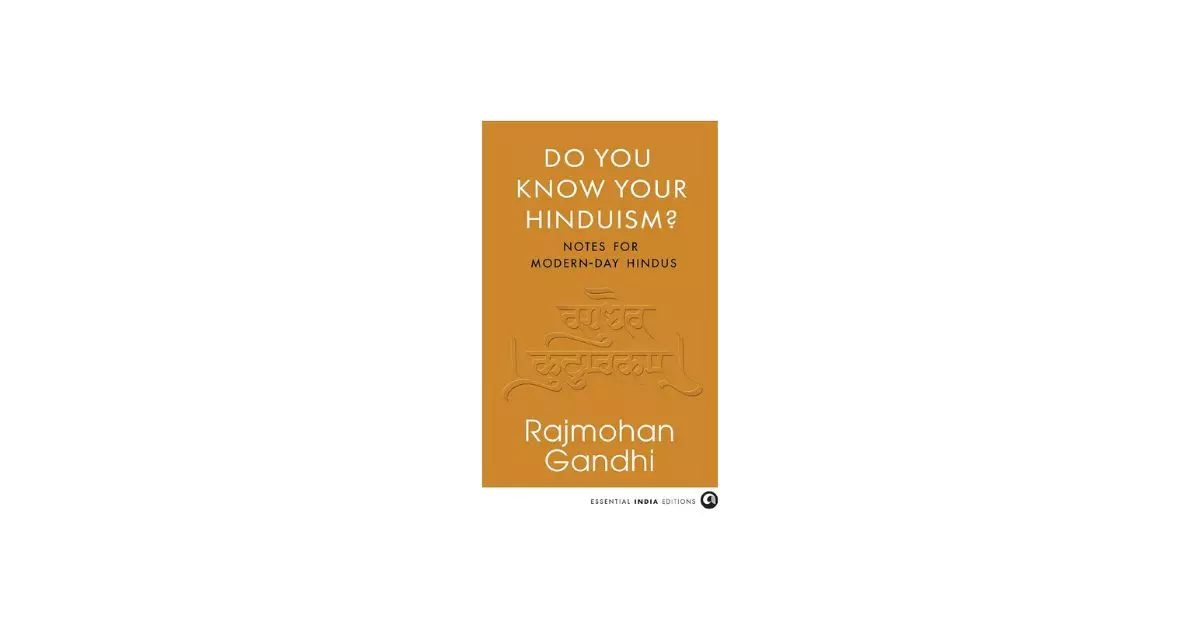
This is not a book of Hindu catechism as it might appear in the first few pages. Nor, is it a highfalutin reiteration of the sublime ideas of Hinduism as stated in various texts. Rajmohan Gandhi is asking a rather simple and blunt question: What is it to be a Hindu? That is, what is the stance that a Hindu should adopt towards other human beings? What are the Hindu’s sense of values that influence his/her outlook and behaviour? Though he raises prickly issues, Gandhi is not engaging in any fierce polemic. He is grappling with the moral question of what it means to be a Hindu. It is a question that he is asking himself as well as asking other Hindus. Without saying so, Gandhi makes it clear that to be Hindu in a society, whether in India or abroad, is a political question.
One of the issues that he grapples with is that of what characterises Hinduism. He draws a parallel with the generally felt sentiment about Christian’s charity, or a Muslim’s faith or a Sikh ‘langar’, which defines a quality. What is the quality that defines the Hindu is the one that troubles Gandhi. He writes, “We speak of a Hindu temple, a Hindu locality, a Hindu school, a Hindu political party. Or of the Hindu community. Not generally of a Hindu gesture.” He concedes that on occasion the phrase ‘Hindu stoicism’ is used. It is easy to quarrel with Gandhi for being too simple, and even being simplistic. But it is only when Hindus confront the basic questions about themselves that one comes upon the truth.
He points out the problem that a Hindu faces. He points out that Hindu parents do not raise their children on the basis of concepts and precepts stated in the Upanishads. He points to the real difficulty: 99 per cent of Hindus do not know Sanskrit and the Hindu texts are all in Sanskrit. Citing the much-flaunted phrase ‘vasudhaiva kutumbakam’, Gandhi remarks in a tone of unmistakable irony, “While this old Hindu insight is amazingly relevant at this stage of our world’s journey, no one should pretend that Hindu parents have been raising their children on that insight, or on the pair of words that summarise it.”
He devotes a chapter to Mahatma Gandhi’s Hinduism, and he says he is doing so because he has studied the Mahatma closely and not because “other Hindu thinkers are less significant”. But the focus on the Mahatma’s Hinduism fits in with Gandhi’s theme in the book: What is it to be a Hindu? That is, to be Hindu in the public arena, and in one’s interactions, thinking and one’s dealings with other human beings. You are not Hindu in a cloister but in the world.
Do You Know Your Hinduism?
By Rajmohan Gandhi
Aleph
pp. 160; Rs 499
