Karan Singh’s life was not that of other royals whose states had merged with India at the time of Independence
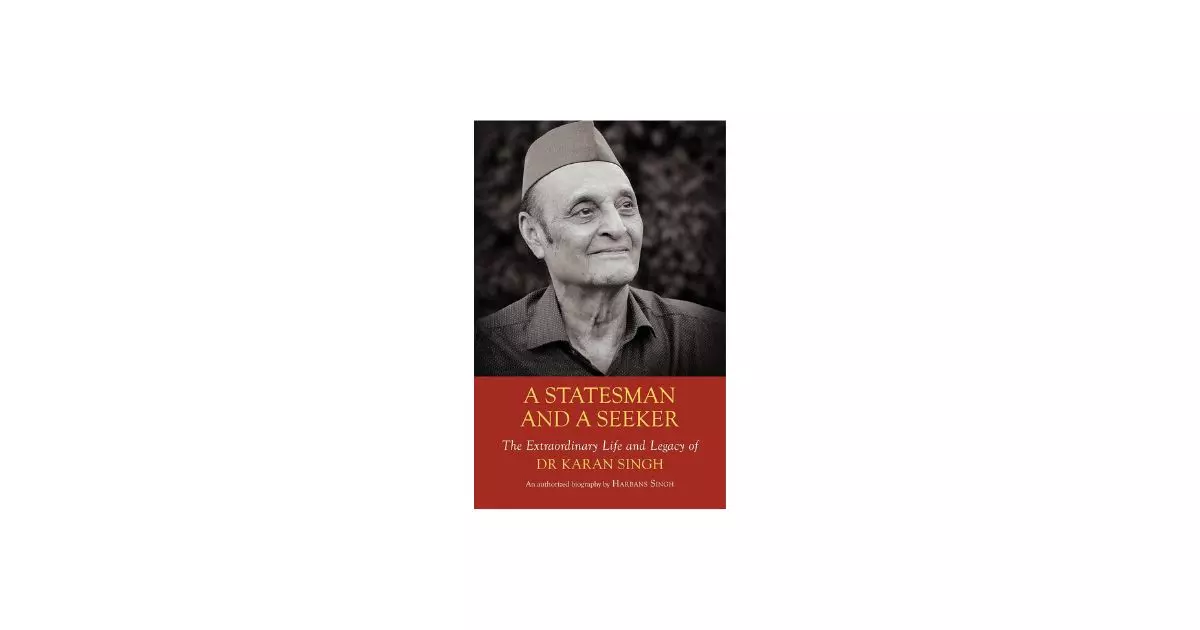
Authorised biographies do not inspire trust. But this one is different. It is based on political developments in Jammu and Kashmir. And it narrates the events from the perspective of Karan Singh, who was neck-deep in the crisis-ridden politics of the state from its accession to India in October, 1947 through 1965. Harbans Singh unfolds the events in a clear narrative. As a biography, and that too an authorised one, it shows the role of Karan Singh. It was an important role. And it provides an important perspective.
Karan Singh’s life was not that of other royals whose states had merged with India at the time of Independence. The royals in other princely states had to sign the accession or merger papers, and retire gracefully to their private places and estates which were left to them. If some of them had come into politics, like Vijay Raje Scindia of Gwalior and Gayatri Devi of Jaipur, they did so on their own. In the case of Karan Singh, the special circumstances of Jammu and Kashmir made it imperative to give the royal family a special constitutional role in the administrative system.
Hari Singh was forced to abdicate because the then popular leader in Kashmir, Sheikh Abdullah, was daggers drawn with him from an earlier. Hari Singh showed no signs of being accommodative. Nehru and Patel and Abdullah had however felt that the presence of the royal family was essential because the ruling family of Dogras had held Kashmir and Jammu together. Secondly, Harbans Singh, makes the important observation that it was the Dogras who had created the state of Jammu and Kashmir as it had existed in 1947, which included Ladakh, Gilgit, Baltistan. It was an artificial state. After the Pakistan raiders were held back near Srinagar, Kashmir, Jammu and Ladakh remained with India. Sheikh Abdullah knew the symbolic importance of the Dogra ruling family in holding the different parts together. Karan Singh was pushed into the vortex as it were as Regent at the young age of 18.
The state convened its own constituent assembly, drafted the constitution and passed it in 1952, accepted the state’s accession to India, and devised the special formula of Sadr-E-Riyasat, elected by the assembly to be the head of the state, while the head of the government was the prime minister. Karan Singh became Sadr-E-Riyasat. And as the constitutional head of the state became instrumental in the dismissal and arrest of Sheikh Abdullah in 1953, the removal of Bakshi Ghulam Mohammed who succeeded Abdullah because of rampant corruption, and the imposition of Governor’s Rule after the Hazrat Bal crisis when the relic of Prophet’s hair went missing in 1963 and plunged the state into a deep crisis, of mainly law and order and the incendiary presence of Abdullah who was released by a confident Bakshi Ghulam Mohammed.
Karan Singh was steering the state as a constitutional head, constantly in touch with Nehru through official communication and personal visits. It was a baptism into democratic politics for the royal and Karan Singh took to it with a huge sense of responsibility and with rare flair. After 18 years as the head of state in Jammu and Kashmir, Karan Singh moved to Delhi and immersed himself in national politics, But those initial years remain crucial and of utmost importance for both Jammu and Kashmir and Karan Singh.
A Statesman and a Seeker: The Extraordinary Life and Legacy of Dr Karan Singh
By Harbans Singh
Speaking Tiger
pp. 478; Rs 999/-
