A richly researched exploration of Mughal India that reveals how trade, merchants and markets shaped imperial power, offering fresh insights into the economic foundations and social fabric of the empire.
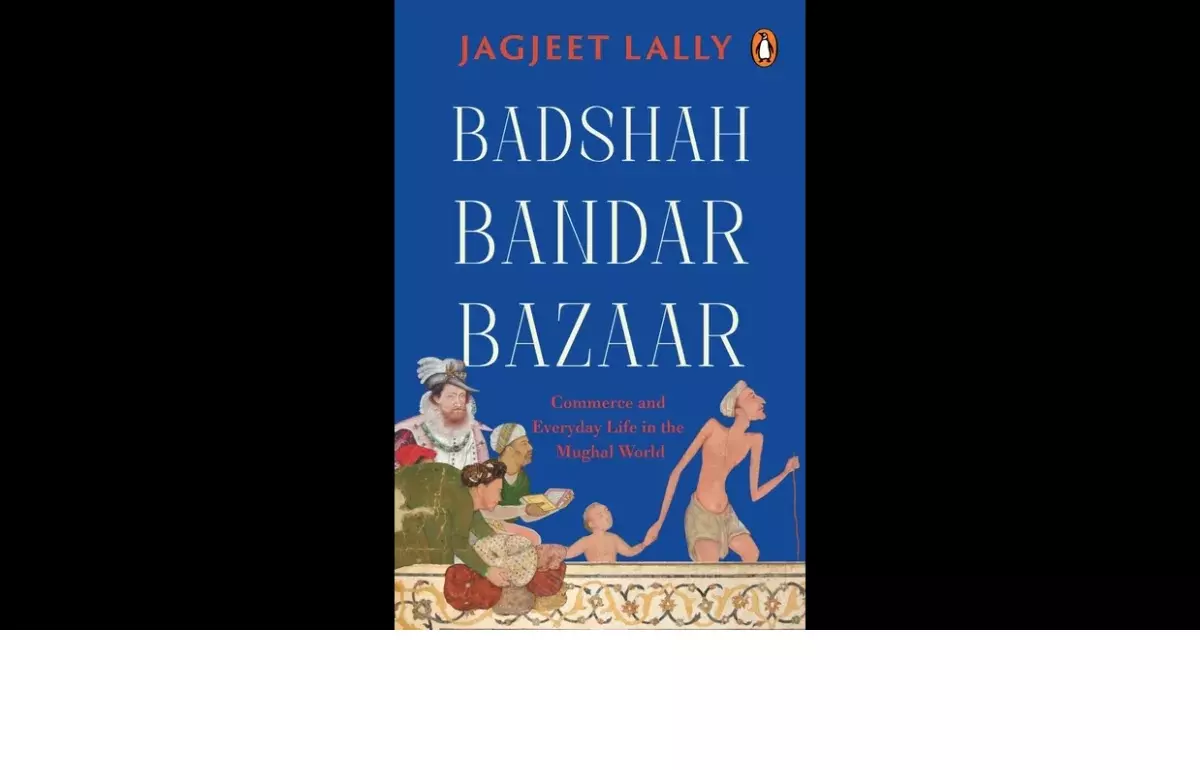
In English it’s “Monarch, Port, Merchant”, as each of six chapters has a narrative with a question. “Was the Mughal state a mighty giant, an all-powerful leviathan of sorts?”
The chapter, ‘Eyewitness in the Bazaar’, states, “Trade expansion resulted in more cash in economy and standardisation of coinage and more uniformity.” Contemporary observers like Guru Nanak (who died 1539) and diplomat Thomas Roe have described the Mughal economics which “built the state upon trade and exchange in a fundamental way”.
“What a city!” exclaimed Chandar Bhan Brahman from Punjab, in his Char Chaman (Four Gardens), on his arrival and during his subsequent professional life in Shahjahanabad (today’s Old Delhi) during Shahjahan’s rule. He rose to be personal secretary and diarist to Emperor Shahjahan.
“Keeping it in the family” is the mantra of the Hindu trading class to this day. From his pre-teens, a boy is taught to contribute to his family’s flourishing business by watching his father’s transactions and book-keeping from the escritoire. The boy also ought to get the hang of Persian, then “fast becoming lingua franca from Balkans to Bengal as it’s the official language of 17th century Mughal state”. Besides, he must “master the embedded and subtle language of gesture, facial expression and comportment necessary to build trust with patrons, partners, rivals and clients”.
An “Agarwal boy’s education” also required “more formal and structured lessons”, sitting with “Brahman pandit in pathshala or madrasa” during the eight years or so separately needed to learn the “art of spotting counterfeit coins and assaying of gold and silver and knowledge of operation of credit”.
Of course, not all of the Indian mercantile actors were part of family firm or acting on behalf of their household or under any other guise of family. Nevertheless, despite their financial success during the Mughal era “banias and other commercial actors seldom penned their histories or biographies”.
On higher echelons, the Mughal state’s success in overall economics pulled Europeans into the Emperor’s Durbar. The maximum revenue, though, came from East Bengal. Easier and shorter sea routes first brought British to Surat (Gujarat) where the Emperor Jahangir’s firman allowed them to establish a factory in 1613. Known as “Bandar-e-Mubaraq” or the Auspicious Port, Surat constituted the hub of this “Bandar Bazaar” complex.
The opulence also had its ill effects. When devastating famine hit Gujarat in 1630-1632 and large numbers of people perished, “for others it presented numerous opportunities”. As life in famine-hit city neighbourhoods came to a standstill, property change hands and inter-religious disputes sprung. That increased the importance of the “Qazi’s court” and expansion of the legal profession for these prosperity-generated conflicts had high stakes. This development makes sense of the Mughal legal order and its relationship to the economics of the empire.
After his ascension to the throne in 1605, Jahangir’s Twelve Decrees, to be observed throughout the empire, came into being with the first three related to trade and mobility. The provincial governors were frequently accused of imposing numerous taxes arbitrarily for their private gains, thereby exposing the dark side of the empire, the age-old corruption in the Indian system.
The book certainly brings these fresh perspectives on society and economic traditions. It’s an interesting, credible and scholarly work.
Badshah, Bandar, Bazaar
By Jagjeet Lally
Penguin
pp. 232; Rs 399
