Women are also subjected to toxic positivity and life-threatening conduct by narcissistic and misogynistic parents along with offenders who purport to care for orphans within an unequal, insensitive, and ignorant society
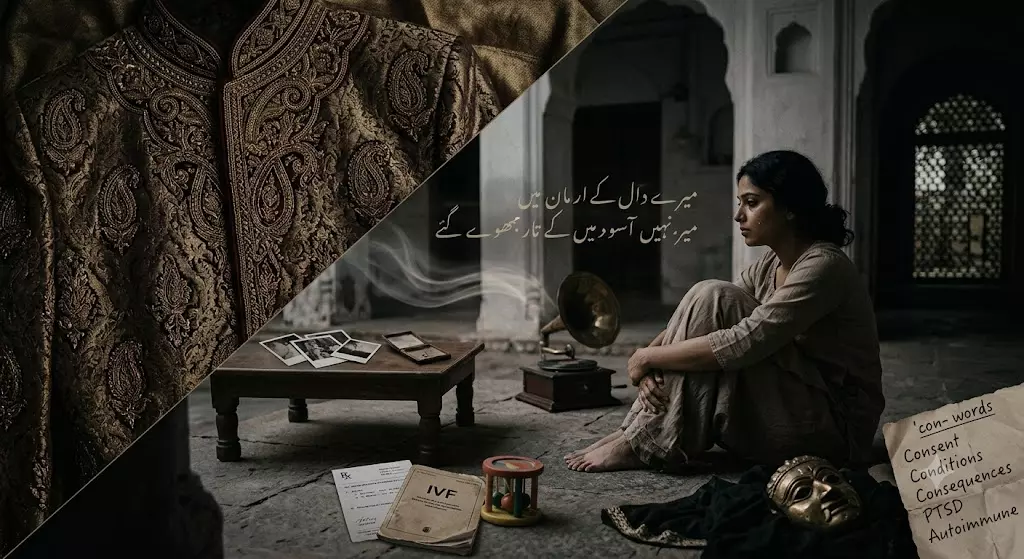
Consent, conditions, and consequences. Contradictory words commencing with “con”—a rather apposite prefix for a connoisseur of the press, where ink confers authority, headlines construct reputations, and the fine print tries to conceal more than it can reveal.
An elementary editorial caveat: better circumspection than conjecture, caricature, or criticism that confuses cinema, catharsis, and controversy with comprehension of the individual or conclusions about them.
Here, pedigree meets pedagogy; privilege comes with its own press release—Vasant Valley, the India Today Group’s finishing school of the patriciate, which I had the quiet honour of attending, where education now meets adjudication.
The media descend like vultures upon the carrion of controversy; Machiavellian designs take wing in the political arena—a Rashomon of competing narratives circling the same carcass, each scavenging its share of the pickings.
Women are too often brought before a double tribunal: judged by men for what is done to them, and by women for how they respond to it. Their clothes become evidence, their conduct an indictment, their testimony subject to cross-examination. Their very character is put on trial—not merely for what has happened to them, but for how they choose to endure it. If they speak, they are accused of manufacturing a case; if they remain silent, their ordeal is deemed unsubstantiated. Yet tribulation has no admissible demeanour. Some women testify; others withdraw. Neither requires a verdict.
Women like me are left to bear the corporeal consequences—autoimmune disease, hyperosmia, PTSD, TMJ, ischaemic strokes, misophonia, and anaphylaxis. Here highly sensitive children that are adopted endure chronic abuse, and abandonment from birth into adulthood despite compelling evidence of lived experiences and sustained efforts to reconstruct life in the face of unremitting and intractable adversity — where careers, family, health, friendships, relationships, and dignity are systematically eroded or appropriated, leaving affected individuals disabled, scapegoated, persecuted, and pathologised.
They are also subjected to toxic positivity and life-threatening conduct by narcissistic and misogynistic parents along with offenders who purport to care for orphans within an unequal, insensitive, and ignorant society — even after personal triggers and vulnerabilities are clearly communicated. Intimidated with police intervention and coercive medicalisation without their consent, yet conspicuously ignored, derided and degraded when they themselves are in need of aid, only to be accused or presumed to be mentally unstable — fostering fear, anxiety, depression, distrust, and diminished self-confidence, which is why so many have become fatigued by the perpetual burden of having to justify self-defence that is subsequently characterised as elder abuse. Such individuals don’t require therapy but courage, custodianship, communication, compassion, and consistency — not continual criticism.
Yet the very same arbiters who once scrutinised the moral propriety of girls at school appear to retain their jurisprudential zeal when their own fathers’ names surface in allegations of grave misconduct. A rather exquisite form of generational ethical exceptionalism: vociferous in its prescriptions for others, yet conspicuously refractory when the indictment arrives at their own doorstep.
Not every bruise is corporeal. Words can cut deeper than skin can register, leaving trust to bleed in silence. What begins as a compromise of dignity can become a fracture in the self; what heals may leave a scar—not merely evidence, but a testament to survival. Dignity is not the absence of protest, but refusing to let a diagnosis become a prognosis.
What is loathsome is the insistence exhibited by the enablers of a sexual offender that, “He never laid his hands on me” or “we were not present to witness what transpired,” as though their absence could somehow invalidate the account of what occurred. Such conduct may be contingent upon opportunity, perceived vulnerability, the asymmetry of power, anticipated consequences, interpersonal limits, prevailing circumstances, psychological disposition, or the influence of stimulants. We remain reluctant to acknowledge that an individual may disclose radically divergent facets of character to those around them—a Jekyll and Hyde we would rather leave unacknowledged.
My former paramour’s erstwhile spouse: an improbable screenplay of arranged matrimony, allegations, and grievance. A costume designer by profession, she draped herself in silver-screen grandeur, while the seams of the narrative frayed and the buttons of the façade came undone. Yet, when an exit presented itself, she chose to remain on set—an unsettling testament to how readily personal dignity was subordinated once pecuniary advantage and continued relevance entered the script, while his family tree made Bollywood’s casting seem to branch through his bloodline rather than proceed by audition.
And therein lies the sartorial punchline: apparently unable to attire her severely disabled child—clad in second-hand couture, allegedly amid squalor and debauchery—while remaining perpetually underdressed for the one role that mattered: responsibility.
Beneath the patina of distinction that enshrouded the elite, what had been meticulously concealed began to unravel, much like the loose threads of his monogrammed membership coat, made-to-measure at a Savile Row atelier.
Burlesque cabaret, masquerade balls, clandestine speakeasies, surrealist installations, fraternal affiliations with the Freemasons, Mapplethorpe-esque tableaux, hidden lairs of absinthe-fuelled hedonism, and a cabinet of alchemical extracts, each tinctured with a suggestion of debauchery. It was an adult Disneyland: men became carousel horses, revolving around you as desire ushered the psyche down a rabbit hole. Cocaine was presented with the studied nonchalance of caviar, served upon silverware.
Just as we knew the Rothschilds through my grandfather’s closest confidant—whose familial alliance had brought him into the dynasty—so too did cocktail anecdotes occasionally allude to other names that would later surface in the Epstein dossier.
There was narcissism, misogyny, hypocrisy, polygamy, and pathological deceit. It was a vignette lifted from Stanley Kubrick’s cinema—a kaleidoscopic cast of characters spanning the eccentric, quaint, and queer.
At one level, this Jannat possessed an ineffable nazakat, yet remained permeated by profound pathos. As though passing through a kaman, one was ushered into a realm whose husn unfolded like a charbagh in bloom, its paisleys and motifs evoking the intricate naqsh of a jamawar. A relationship woven with tameez, saleeqa, shiddat, and sukoon—a language of gratitude and dua, touched by ruhaniyat. And through the deori drifted the strains of ‘Mere Dil Ke Armaan Aansoo Mein Beh Gaye’—a quiet reminder that even blossoms fade and wilt, and that the most soulful connections, too, can wither when they are no longer tended with care.
As my professional routine proceeded in earnest, I sought to restore tombs and palaces while petitioning artisans to exhibit brass Bhuta masks, Telia Rumal, and Kalamkari at the Crafts Council.
Much to my dismay, our once-meaningful interlocution gradually descended into rancour, increasingly vitiated by his parents’ imperious insistence that I convert. In one such instance, he drew his pistol and levelled it at his butler’s knee for failing to furnish the particulars he demanded; later, he drove my face against a wooden jaali, its filigreed apertures admitting the adab of light even as truculence eclipsed it. I had to compromise my dignity, capitulate to coerced conversion, conceal my form beneath the chador, assume the custodial care of the family, conform to their creed, conceive children, and countenance corporal abuse.
I divested him of the attire he had been wearing, anointed him with oils, and exfoliated his skin with salts before offering him something wholesome to consume. As I applied tinctures and unguents to his fractured arm, we embraced and lamented.
I was profoundly discomposed by the thought that, if we did not extricate him from his circumstances, the media would subject my parents to public vilification. Yes, some of us endure the histrionics because: 1) we believe every soul deserves an opportunity to elucidate itself; 2) we believe karma exacts a reckoning from those who remain indifferent to a soul steeped in melancholia; 3) society might construe our inability to intervene as capitulation; and 4) beginning anew would itself be depleting, particularly for a man of breeding.
He elected to drive me to his farm to offer an apology—an act of vicarious atonement. As a stockowner, he had livestock vaccinated and subjected to branding with incandescent iron rods before Bakrid. The practice of animal sacrifice, deemed halal—permissible—was particularly heinous to me.
Yet, owing to the paucity of network towers, I found myself entirely bereft of resources, provisions, assistance, or any meaningful means of communication, stranded upon a rocky hill at his stud farm on the outskirts of Hyderabad.
The terrain was encircled by gnarled roots and dense foliage, their tendrils entangled deep within Mother Earth, accompanied by the ominous susurration of leaves, snapping twigs, and the dry crunch of foliage and gravel beneath my feet. The hooting of owls sent a ripple of horripilation across my skin.
The gnarled tree against which I reclined exuded a viscous secretion, its adhesive sheen redolent of reptilian integument. Vines writhed with the supplication of the penitent, reaching skyward as though imploring absolution, while spectral plumes of moss descended from the boughs like the entrails of poltergeists.
A gargoyle and an Angel of Death stood sentinel beside a tombstone engraved with our names, encircled by the silent vigil of grimalkins, extinguished wicks, and scattered petals.
Meanwhile, his mother, pedantic even amid her histrionics, demarcated the boundary between Hindus and Muslims with the same uncompromising severity as the Wagah border.
The lexicon of my most lugubrious recollections appeared virtually inexhaustible: vitriolage, vivisepulture, vivisection, venenation, vilification, violation, and victimisation—alongside the vindictive and the vexatious. This was her disposition—and her intent, epistolised with chilling particularity: the lethal means she had ordained for us.
For me, the most blood-curdling of the P’s were plague, promiscuity, penitentiaries, parturiency, psychosis, and predation.
She was manifestly unwell—dispatching amorous missives to a former Prime Minister of Pakistan, conducting obsessive reconnaissance on people in India, and publicly castigating, denigrating, and haranguing young women online.
I was informed that, at the age of four, her son had used a safety pin to pierce his cousin’s most intimate anatomy before sending her hurtling down a flight of stairs, after observing his mother repeatedly perforating a poppet.
Our Polaroids becoming his taxidermy—a Duchampian portable museum of what we had been.
Some were schooled to construe silence as concord; others learned to apprehend it as the harbinger of rupture. Even as we embraced our affinities and honoured our differences, in the final reckoning, being silenced constrained me.
As Faiz wrote, “Nahin nigaah mein manzil to justajoo hi sahi, nahin visaal mayassar to aarzu hi sahi.” I wept inconsolably while listening to Abida Parveen on my gramophone, her voice inhabiting the sher, while onions were sliced and kebabs assiduously pounded by hand. With every translucent stratum that peeled away, the anguish seemed to deepen until the innermost core was reached.
For generations, the aristocracy had dispatched their children to Harrow and Gordonstoun, preceding Eton’s eventual ascendancy as the preferred alma mater.
At this juncture, how was I to raise a child who might be socially ostracised merely for choosing to attire herself in a hijab? What if she were required to recite suras five times a day? What if a taweez were to rest against her throat? What if she were subjected to physical assault or psychological brutalisation? What if the racial epithet “Paki” were indiscriminately hurled at her? In this city, metal trishuls and printed swastikas upon saffron flags, festooned with golden tassels, proliferated at every conceivable turn.
How was I, as a prospective second mother, to construct a sanctuary for a child who might be persecuted by those aware that pork was haram to her and that her diet was circumscribed by halal observance? What if an individual abducted her and violated her autonomy? I could not countenance the prospect of her being displaced. Though I possessed the requisite skill, I knew this from having helped an eight-year-old girl who was unable to communicate verbally reclaim her voice through the therapeutic language of art.
Some of us yearned for progeny yet found ourselves unable to conceive, and so we adopted, underwent procedures such as IVF, or elected to pursue surrogacy. We had all been endowed with disparate physiologies and bodily dictates, each of us possessing our own idiosyncratic metabolism.
Now and then, I found myself peering beneath the spoonful-of-sugar veneer of a family. By some accounts, the mythological allusion was Mary Poppins: a daughter’s nursery was kept spick and span. Pie-crust promises, perhaps. It left one wondering: how does one person enable another not merely to be practically perfect, but also to introduce an element of levity into their dysfunction?
Listening to young women reciting the Qur’an, I was overcome by an inexplicable gratitude. Umeed was the sole reserve I possessed. At the Maula Ali Dargah, I offered a chaddar; five hundred steps had to be ascended before one could attain sukoon.
Meanwhile, the infant’s hand-eye coordination was becoming increasingly assured, although she had not yet acquired object permanence. Conspicuously tall for her age, a residual squint and an absence of vocal cords. Even preschools purporting to accommodate children with additional requirements proved incapable of providing the care she necessitated. I scoured the city for an occupational therapist and a speech therapist, navigating a system in which even the most basic accommodations seemed elusive, while inhabiting a dystopian India in which identity itself appeared to be undergoing a gradual dilution.
To extend an extraordinary degree of solicitude, fidelity, and commitment, far beyond what could reasonably have been expected of a matrimonial partner and compassionate caregiver. To shield him from institutionalisation at the hands of the authorities, even after conduct had deteriorated into acts of abuse and violence; to embrace him as part of a strictly observant Madhva Brahmin family and stand by even through Ramadan. To understand the quiet grammar of care: the governance of a household, the innumerable exigencies of daily life, the pursuit of a career, the discipline of consistency, and the courage to remain steadfast as a woman of another faith, while preserving dignity and composure throughout.
To believe that a relationship was never a fairy tale, but an ongoing exercise in communication and a conscious determination to remain through its vicissitudes—the seasons of ease and adversity, affection and discord, prosperity and strain—and to articulate what was arduous rather than permit silence to ossify into resentment. To know how to love without reservation, forgive without surrendering self-respect, and retain gratitude for what had been given—virtues I bestowed without parsimony, yet encountered only in scant measure in return.
Some of us are already secure in the life our parents afforded us endowed with stability, privilege, and the distinction of having known the best of both worlds. No extrinsic distinction was sought from life. Love, in its purest form, was sufficient. Opulence, eminence, and ascendancy held no currency for many. Abandonment and abuse were not sacrifices I was prepared to dignify as the price of love.
My parents were collectively beset by grave infirmity and confined to hospital wards, while my grandparents were taken with devastating suddenness. Compulsory optimism and the indignity of dependence only compounded an already harrowing ordeal.
An almost-mother-in-law was, for a time, content with my presence and solicitude as I commenced preparing for the Ivy League, while she placed in my hands a treatise on the Islamic jurisprudence of zina—a decidedly incongruous invocation of religious doctrine, given the profound discord already besetting her son’s previous marriage, his contemplation of triple talaq, and his subsequent issuance of a formal notice of dissolution.
It was only when I drew a boundary in defence of the dignity, values, and honour of my family that the matriarch’s disposition towards me underwent a marked alteration. She appeared to privilege religion, gender, filial hierarchy, and an antiquated moral schema over the preservation of the bond entrusted to her. She invoked the Christian ideal of a family, while her own conduct ultimately served to deepen the very fracture she had once professed to deplore. Her worldview appeared rooted in a Victorian sensibility, anachronistically removed from the exigencies of the present.
To casually characterise women as psychologically aberrant without comprehending the anguish they have been compelled to endure is its own form of callousness. Silence often becomes an involuntary refuge when those around women lack the empathic acuity to apprehend what lies beyond articulation.
Therapeutic intervention, too, carries its own pharmacological burdens; its side effects can alter disposition, cognition, and comportment in ways invisible to those who witness only the aftermath. To reduce such desolation to an admonition against the supposed indignity of lamentation, or to an insinuation that one’s emotional state might be hormonally governed, is not merely reductive; it is a facile dismissal of pain through the vocabulary of internalised misogyny.
Kya kasoor aur kismet, bas ek buzdil aur dagha-baaz haqeeqat
Woh tha meri zaroorat, aadat aur mohabbat
Ab—bas nafrat, tanhayee, takleef aur ghabrahat.