Dwelling upon the past, I realised how profoundly the city had metamorphosed, yet, amid the contemporary, the antiquarian remained meticulously preserved
With eyes like Verde Indio marbles, a chiselled face, pale skin, and rose-tinted lips—a distant relative of the Nizam and an equestrian—he came with pedigree in both blood and saddle. Our grandfathers served in government; our fathers were delivered at the same convalescent home, attended by the same obstetrician minutes apart, and went on to attend the same alma mater. In the ’80s, he would ride from the stables to visit my parents on Road Number 12, Banjara Hills.
His portal to Narnia had opened. I was obliged to attire myself in a fascinator and a knitted pencil-skirt-and-jacket ensemble, while wagering was duly sanctioned upon the grounds. I wandered through the stables, where a farrier wrought iron upon the anvil before nailing horseshoes to hooves, and a leather artisan embossed the saddlery.
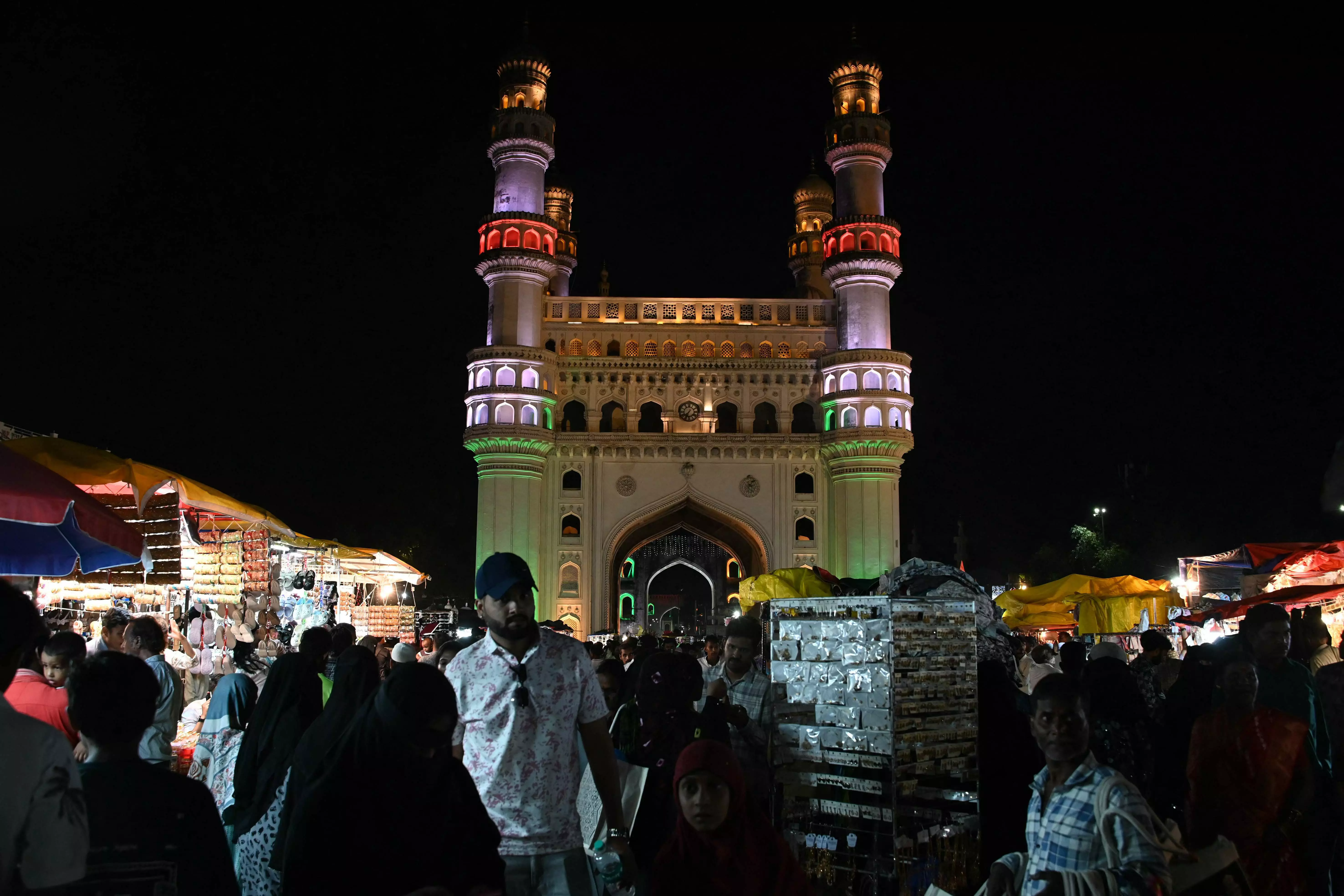
We spent an afternoon by the Charminar—from the fragrant shavings of timber at a venerable framer’s atelier, Abbas and Co., to lac bangles being shaped before me, their surfaces bejeweled with tiny mirrors, to Munshi’s ‘char-koni’ naan baking within an insulated subterranean mud oven, and an antiquated perfumery where crystal flacons were arrayed along mirrored shelves. Each aroma summoned a recollection of my childhood.
Possessed of an irrepressible inquisitiveness, I found myself drawn to the arcana of Varq—the painstaking process of manually pounding particles of silver or gold between layers of ox gut or cowhide, traditionally applied to Hindu deities, rose-petal preserve, and Badam Ki Jaali, a scalloped almond confection, crowned with a delicate lattice of edible silver.
He resided in an ancestral bungalow in Hyderabad and was distantly related to a plutocratic coterie ensconced in Lutyens’ Delhi. Our dalliance was brief, though sufficiently diverting. They frequented art biennales, literary salons, queer theatre, avant-garde screenings, philanthropic auctions, défilés de haute couture, polo matches, nocturnal cabriolet drives, palatial nuptials, candlelit Michelin-starred repasts in historic edifices, and birthday fêtes on superyachts.
Political salutations were coined by his great-granduncle, Abid Hasan Safrani, during India’s independence, while his great-grand aunt, Suraiya Hasan Bose, was united with Subhash Chandra Bose’s nephew—a textile conservator who was instrumental in the Swadeshi movement in Hyderabad and devoted herself to the restoration of ikat, himru, and mashroo.
His kitchen, where I sat, was redolent of za’atar and lamb manakeesh, baked in a telluric clay kiln, alongside ras el hanout, saffron, and Qabooli pilaf baked in a terracotta tajine.
The garden had a stone bird bath and was replete with wooden benches, rose arbors, and beds of hollyhocks, lilies, dianthus, tulips, poppies, hydrangeas, peonies, and lavender. My paternal grandmother used not only to tend to but also to host her English tea soirées with tiered stands laden with lavender shortbread, avocado and salmon finger sandwiches, carrot cake, Camembert and asparagus quiches, clotted cream scones, elderflower and cucumber mocktails, and English breakfast tea in a silver teapot with slices of lemon and a spot of milk, served upon botanical China and placed in Scottish tartan-lined wicker hampers.
Later that evening, my grandmother’s birthday unfolded amid an illustrious coterie: Abid Husain, a seasoned hand in statecraft, waltzed with her, while his brother, Irshad Panjatan, evoked Marcel Marceau through pantomime, and Vidya Rao, of the Rameshwar Rao and Hydari lineages, lent her voice to the evening, over a repast drawn from Pratibha Karan’s heirloom culinary repertoire, a Hyderabad that Narendra Luther would later chronicle in Legendotes of Hyderabad, where he recounts my great-grandfather, B. V. Rama Narasu.
I apportioned my days into three, with each hour taking me to a different facet of the city.
At dawn, I walked among the tombs and mausoleums of Qutb Shahi and Paigah, where mortality acquired the finest aesthetic of aristocracy: marble, stucco, filigreed jali, and onion domes transformed the permanence of the graves into an elaborate exercise in impermanence—a reminder that even monuments erected to withstand the attrition of time ultimately commemorate what could not.
The morning commenced with a metro ride to Goshamahal, where my grand-uncle was a Freemason; the square and compass, with their pretence of precision, made an oddly apposite insignia for a fraternity whose secrets were designed to resist measurement.
By noon, a three-wheeler, its mechanical fare meter clicking with each turn, took me through the patli galiyan of the Old City and around Moazzam Jahi Market. Famous’s ice cream, Nimrah’s Irani chai and Osmania cookies, Subhan’s chand biscuits, and Hotel Madina’s lukhmi, biryani, and haleem were among the modest indulgences of the nineties; the twenty-first century has refined them into a lesson in intestinal scepticism.
In the afternoon, a double-decker bus dropped me at the British Residency, which rose on marble steps beneath its vast classical portico, flanked by stone lions and frescoed walls—where James Achilles Kirkpatrick’s clandestine union with Khair-un-Nissa remained an undisclosed chapter until William Dalrymple prized it from the archives for White Mughals.
Soon after, I visited Hill Fort Palace, with its castellations and neo-Gothic arches recalling Trinity College, Cambridge—formerly the Ritz Hotel—and I was reminded of Sir Walter Scott’s castles.
At dusk, I cycled to Raja Bhagwandas Bagh. The wooden pavilion—with its floral and peacock carvings and projecting jharokas—drew Mughal and Gujarati artistry into confluence; the family’s own foundations, however, proved no firmer than the union they had once imagined with me.
By evening, a horse carriage took me to Chowmahalla Palace, Purani Haveli Salar Jung Museum, Saifabad Mint Museum, and Falaknuma Palace, which unfolded like his palatial residence—brocaded upholstery and embroidered bolsters softened the rosewood furniture, while silken draperies fell over Persian carpets beneath the refracted glow of chandeliers and Tiffany lamps. Zardozi textiles, jade- and gemstone-encrusted swords, monochromatic photographs, and Persian miniatures enriched the walls.
The cultivated abundance extended to accoutrements: himroo sherwanis and velvet-and-zardozi mojris wove Deccani textile traditions through his attire, accented by ashrafi and bidri buttons. Coloured stemware lent the dining table an elegant refinement, alongside silver huqqa stands, jeweled and enameled boxes, and hand-painted porcelain on bone-inlaid tables. Silver paan-dans, repositories of olfactory intrigue, concealed in their recesses a distinct gustatory register.
Beyond the interiors, courtyards opened onto marble fountains and mosaic floors, their geometry reflected in Venetian mirrors and framed by intricate latticework of jaali screens that concealed vintage automobiles. Palaces once shaped by tehzeeb and zauq now require neither.
At night, I was chauffeur-driven in a cabriolet for an open-air film screening of my grand aunt’s monochrome movie, during an era of single-screen theatres, hand-painted posters, and hand-built sets at Ramoji Film City, to which one drove in a coupé. Today, we have green screens, VFX, treadmill-running sequences, and Dolby Atmos at Annapurna Studios—cinema has evolved from the tangible to the simulated.
His grandaunt, a frequent patron of Studio 54, was engaged in a photoshoot when I called on them. Her corridors were redolent of oudh and bakhoor and led to a hammam she had created with milk, honey, and rose petals. Incense pellets and Dead Sea salts were kept in containers fashioned from gold, alabaster, glass, and semi-precious stones, carved in the likeness of animals and goddesses, while unguents were housed in canopic or calcite jars. Siltstone palettes were used to grind and crush mineral stones, nuts, herbs, roots, and dried flowers into kohl, oils, and lip and cheek pigments, which were then applied with ivory and mother-of-pearl combs, apparatuses, and applicators.
I watched the minute stippling that trailed from his mastoid along the nape of his neck; when he sat beside me, it resembled scattered constellations strewn across a midnight firmament. He would unfailingly hold the door and draw out my chair with the quiet courtesy of a man of breeding—gestures of old-world gallantry that lent an almost anachronistic elegance to his demeanour. It was a Disneyesque magic-carpet ride into a whole new world beneath the crescent moon.
As the khus-infused bamboo screens fluttered in the breeze, I recalled my grandfather recounting a conversation with Bilkis Alladin, a heritage conservationist, who spoke of Errum Manzil—a palace of Doric and Corinthian pilasters, horseshoe arches and Romanesque semicircular openings, later subsumed into the machinery of government. He told her that the waddars, stone-cutters who resided in wattle-and-daub huts at the foot of Road No. 12, were considered primitive, hunting wild boar and roasting it on spits amid its granite outcrops—a curious counterpoint to a later era when Willy Jeeps, jerry cans in tow, carried them into the wilderness, emerging with taxidermied trophies before polo became their sporting predilection.
Dwelling upon the past, I realised how profoundly the city had metamorphosed, yet, amid the contemporary, the antiquarian remained meticulously preserved. From the Sailing Club, Tank Bund at sunset evoked the Pont Alexandre III, with its Art Nouveau lamps and wrought-iron filigree. We spent our Sundays viewing documentaries by Nagesh Kukunoor and Shyam Benegal, lending an ear to the urbane anecdotes of Narendra Luther, or imbibing kulhar chai and savouring mirchi ka bajji whilst attending a debate, a performance, or an exhibition at Lamakaan.
I was all of eight when I attended Vidyaranya; my mother taught public health at Purani Haveli and Bella Vista. Telugu was my second language at school, and it was through the gradual acquisition of comprehension that I learnt to enunciate it. I recollect finding it almost labyrinthine to determine how to attire myself each morning, as the school eschewed a uniform except during our scouting pursuits. This inadvertently engendered a certain degree of social stratification and intimidation, as not every child possessed the means to procure limited-edition Disney couture from The Shoppers Stop.
Lunch invariably comprised kache gosht ki biryani and mirch ka saalan, conveyed in tiered, circular brass receptacles—an Indian analogue of a bento box, distinguished by Arabic-Urdu inscriptions incised upon the metal, including shukran. After school, an autorickshaw would convey me to Bella Vista, where Usman, its proprietor, would regale me with a compendium of anecdotes about the city. On days when my father was relieved of his official duties, he would collect me from the school gates, and we would drive to Bakers Inn or Rock Castle Bakery to watch my aunt, Jamuna Rao, rehearse her lines for upcoming films with NTR and ANR, whilst we indulged in chocolate thumbprint cookies and chicken puffs or made our way to a coin-operated arcade at Prime Time.
My father often reminisced that, while visiting a Spanish Villa, the Bilgrami Mansion, with its California-tiled façade and Moorish fenestration, he could hear the distant roars of lions from the Public Gardens, interspersed with the mournful wail of passing trains, an evocative auditory vestige of Hyderabad’s aristocratic past.
Meanwhile, my grandfather received the Nizam, Muffakham Jah, at our Banjara Hills abode for high tea. He spoke of Hyderabad State’s feudal aristocracy and the cultivation of a local Muslim bourgeoisie through Urdu as the lingua franca of education, with even Hindi resisted as a link language. The imperative to preserve linguistic identity was consequently more acute among the Telugus. A participant in the Quit India Movement, he corresponded with Mahatma Gandhi in handwritten letters, receiving replies and blessings from him.
As I conversed with the grandson of Syed Ali Khan, a name synonymous with Supersonic Travels, he recalled his grandmother’s property on Raj Bhavan Road, where, as a child, he viewed aircraft descending into and ascending from Begumpet Airport, while interstate trains streamed past—before the rise of vertical development began to obscure the panoramic vista.
My soul was inclined towards Islam. I was drawn to the ways in which women employed maquillage to reassert and redefine themselves within lives circumscribed by submission and stereotype. The architecture, with its cusped arches, onion-shaped domes, minarets, jalis, and muqarnas, held an unmistakable allure. So did the cuisine, in which edible gold, root, fruit, and floral extracts were incorporated into long-grained rice and exquisitely slaughtered meat, sliced as finely as truffle, then seared upon a solitary slab of granite or prepared within an argillaceous hearth.
The miniature paintings chronicled a kaleidoscope of their history, employing crushed minerals to yield chromatic powders and pastes, with squirrel hair fashioned into brushes upon palm leaves. The acoustics of ghungroos accompanying the predominant footwork metamorphosed into an altogether different character, narrating the philosophies of good over evil through the graceful spiralling of the Anarkali in Kathak. And then there was the music and poetry, summoning a profound melancholia, whether born of the agony of Partition or devotion to a supreme being or an individual.
The mines of Golconda also yielded some of the world’s finest diamonds. Their rarity, optical properties, and provenance made them potent symbols of authority, conferring upon them an almost sovereign value, while zari—gold-thread embroidery incorporating pearls and gems—was hand-worked onto velvet mojris, silk tunics, and farshi ensembles.
Meanwhile, my grandmother’s haveli consisted of a courtyard enclosed by rooms on all sides, with a well tucked away at the back of the house. Its façade evoked the sunlit villas of Gerald Durrell’s Corfu—arched openings, weathered plaster, and terracotta accents, with a distinctly Mediterranean grace.
Inside, the sunken courtyard was framed by dark, engraved wooden pillars, with a traditional swing suspended from the beams and richly patterned Athangudi tiles underfoot. During the rains, water threaded through the brass bells, setting them into a resonant cadence, the house itself becoming another instrument in the music that had long inhabited it. My great-grandmother was a veena virtuosa; my mother, a vocalist steeped in the Carnatic tradition. Between the two, I inherited not merely a heritage but an acoustics of lineage.
The strictures of womanhood were themselves an elaborate liturgy: menstruation rendered the kitchen a forbidden precinct; widowhood demanded the ritual tonsuring of hair, the chromatic renunciation of colour, and the erasure of the bottu. Economic autonomy, too, was withheld, as though agency itself were a form of ritual pollution. On my paternal grandfather’s side, the lineage was decidedly connoisseurial: generations traversed the globe, returning with collectanea, calendar art, and a growing bibliotheca that gradually accreted within the villa.
Meat remained anathema to the household; spices were pulverised by hand, destined either for banana-leaf meals or for the more intimate alchemy of exfoliation. My culinary predilections—avakaya, pachadi, pulusu, vepudu, and vadiyalu—formed the savoury foundation of the banana-leaf meal, while Ugadi pachadi brought together the six rasas of Ayurveda: sweet, sour, salty, bitter, pungent, and astringent.
Each morning, a kolam bloomed at the threshold in rice flour, an ephemeral geometry renewed with the day. NRI relatives, returning to India, would carry appadam back to America, its provenance proudly advertised on the packaging as “Made by Brahmins”—a small, almost comical commerce in caste pedigree. Palm-leaf manuscripts and Vedic recitations carried the weight of an inheritance preserved through generations. During upanayanam, the sacred thread was ceremonially bestowed upon the boys, marking their passage into that ritual and scholastic lineage.
The family’s stepwell served as a ritual precinct, where prayers to Lord Vishnu accompanied the ceremonial distribution of tāmbūlam—betel leaf, a saree or a blouse piece, fruit, and coconut, accompanied by haldi, kumkum, sandalwood, vibhuti, and a hibiscus flower. With each meticulously choreographed rite, however, my soul seemed to descend alongside the temple’s inverted geometry, its receding tiers becoming an architecture of inequality and patriarchy.
At that threshold, I found myself unwilling to inherit a tradition in which caste, religion, and class determined the permissible contours of belonging; the bibliotheca housed the sacred imaginings of many faiths, yet the soul was expected to remain within the narrow precincts of its own inheritance, though the Alam—a ceremonial finial—stood alongside a Tanjore painting, its raised-gesso relief of gemstones and gold rendering goddesses within a wooden frame: two devotions nailed to the same wall, a compromise mistaken for cohesion. Secularism, they call it—though the house itself knows better: shared walls do not necessarily make common ground.